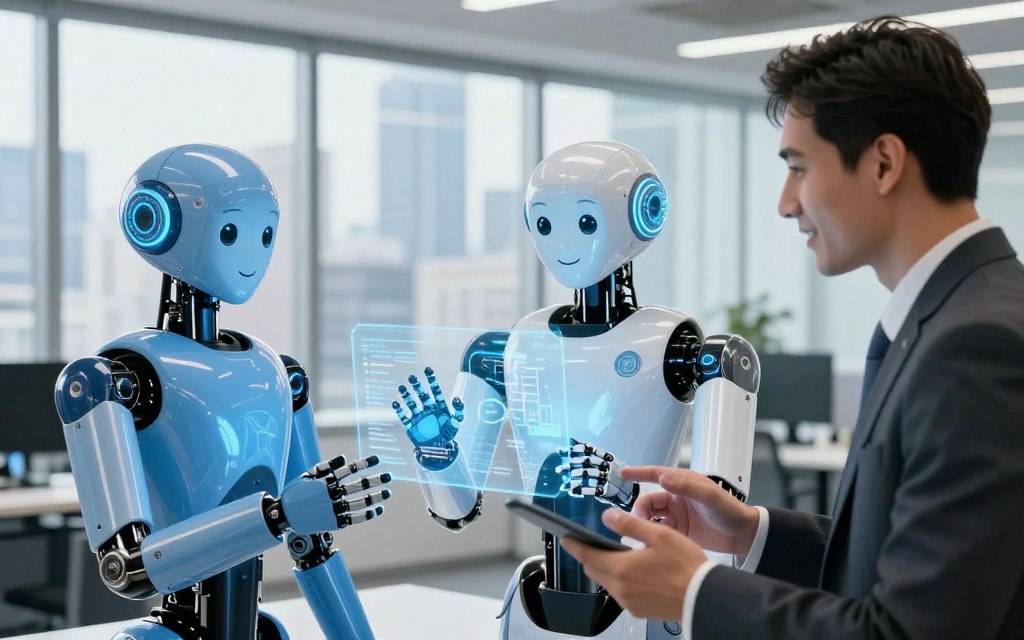

Chatbots are software that acts like a human in conversations. They are everywhere, from smart speakers in homes to tools for work.
The newest kind is the intelligent virtual assistant, or virtual agent. These sophisticated systems can understand and respond to conversations on their own.
At home, we use voice helpers like Siri and Alexa. At work, tools like Slack use AI assistants to make tasks easier and help teams.
The idea becomes more practical when you connect it to are using chatbots today in a real conversational-AI workflow.
These tools are getting smarter, going from simple answers to real conversations. They are changing how we live and work.
Understanding these technologies is key as they grow. This article will dive into what they are, how they’re used, and where they’re headed.
What Are the Chatbots? Defining the Digital Assistant
The term ‘chatbot’ covers a wide range of technologies. It includes simple tools and advanced systems powered by artificial intelligence. Labels like chatbot, AI assistant, and virtual agent show different levels of complexity. This section explains these terms, showing how they have evolved from simple automation to intelligent partnerships.
Beyond Simple Scripts: The Core Concept
A chatbot is any software that talks to humans like they’re having a conversation. It has grown beyond simple scripts. Now, it uses conversational AI, machine learning, Natural Language Processing, and Natural Language Understanding.
These technologies help understand what the user wants. They match the user’s question to the right action or response. This change from simple keyword matching to understanding intent makes a big difference.
A virtual agent is another step forward. It combines conversational AI with Robotic Process Automation. Unlike chatbots, virtual agents can take action based on what the user wants. For example, it can not only tell you your account balance but also transfer funds.
| Type | Core Technology | Primary Function | Level of Autonomy |
|---|---|---|---|
| Basic Chatbot | Rule-based decision trees | Answering FAQs from a set script | Low: follows predefined paths |
| AI-Powered Chatbot | NLP, ML, NLU | Understanding intent and context in dialogue | Moderate: learns and adapts within scope |
| Virtual Agent | Conversational AI + RPA | Completing tasks and transactions autonomously | High: executes actions in external systems |
From Customer Service to Creative Partner: The Expanding Role
Chatbots have grown a lot. They started as tools for answering simple customer service questions. Now, they are becoming creative partners.
Today, advanced chatbots can write marketing copy, summarize reports, or suggest ideas. They help in sales, marketing, and content creation. They can even handle complex tasks, like solving technical issues.
This change shows chatbots are moving from helpers to partners. They are no longer just answering questions. They are now key players in business and creativity, making them essential in today’s work.
The Evolution of Conversation: A Brief History of Chatbots
Chatbot development has seen many phases, each with new tech breakthroughs. These advancements have made digital assistants more like us. Knowing how chatbots have evolved helps us see their current and future abilities.
Early Pioneers: ELIZA and PARRY
In the 1960s and 1970s, the first big steps in chatbots were made. Joseph Weizenbaum created ELIZA at MIT in 1966. It pretended to be a psychotherapist by rephrasing what users said.
ELIZA didn’t really understand language. Yet, people thought it was smart. This shows how we like to see technology as human.
Kenneth Colby made PARRY in 1972. It acted like someone with paranoid schizophrenia. These early systems showed that simple programs could talk to us in a way that felt real.
The Rule-Based Era
After these early days, developers made chatbots that could answer simple questions. These were used for customer service and to give information. They worked well for basic tasks.
These chatbots used decision trees to decide what to say next. But they were limited. They couldn’t handle complex questions or understand language well.
Even so, these chatbots were useful in business. They were used in banking, telecom, and retail. They showed that automated chat could be valuable, even if they were simple.
The AI Revolution: Machine Learning Takes Over
Now, chatbots use artificial intelligence and machine learning. They learn from experience, not just follow rules. This is a big change in how chatbots work.
They can understand human language better now. They can even figure out what we mean when we ask open-ended questions. This is thanks to deep learning and NLP.
Large Language Models (LLMs) are the latest tech. They’re trained on lots of text to respond like humans. These models make today’s chatbots very good at talking to us.
These AI chatbots can now understand us better. They can handle complex questions and even know how we feel. They keep getting better at talking to us naturally.
How Do Chatbots Actually Work? The Technology Behind the Talk
Modern chatbots use advanced AI to talk to us. They don’t just follow simple rules anymore. Instead, they understand and answer us through a series of steps.
This process lets AI assistants read and respond to language. They keep the conversation going smoothly.
Natural Language Processing (NLP): Understanding Human Input
The first step is to understand what we say. Natural language processing (NLP) makes this possible. It helps machines understand human language, whether it’s written or spoken.
NLP turns confusing text into data computers can use. Learning about how chatbots work starts here.
NLP doesn’t just look for keywords. It also figures out our intent, tone, and feelings. This way, it gets what we really mean.
Intent Recognition and Entity Extraction
Intent recognition and entity extraction are key parts of NLP. Intent is what we want to do (like “book a flight”).
Entity extraction finds specific details in our requests. For example, “Book a flight to London next Friday” means “London” and “next Friday” are the entities.
This detail helps chatbots give accurate answers on their own.
Natural Language Generation (NLG): Formulating a Response
After understanding us, chatbots need to talk back. Natural Language Generation (NLG) makes this happen. It turns data into text or speech that sounds like a human.
While NLP is about comprehension, NLG is about composition.
NLG uses advanced AI to create responses that are right and fitting. It chooses the words, tone, and structure. This turns data into a natural-sounding sentence.
Dialog Management: Holding the Thread of Conversation
Human talks are not just one question and answer. Dialog management keeps the conversation going. It remembers what’s been said and what’s next.
This system knows the conversation’s history. It handles follow-up questions and clarifications. For example, if you ask about the weather and then ask about Paris, it knows you’re asking about the weather there too.
It makes the conversation feel like a real talk, not just a series of questions and answers.
| Core Technology | Primary Role | Key Challenge |
|---|---|---|
| Natural Language Processing (NLP) | To understand and interpret human language input. | Disambiguating meaning and handling slang or typos. |
| Natural Language Generation (NLG) | To formulate and generate human-like text responses. | Producing varied, natural, and engaging replies. |
| Dialog Management | To maintain context and flow over multiple exchanges. | Managing complex, multi-goal conversations. |
NLP, NLG, and Dialog Management work together. They make AI assistants smart and helpful. Now, we expect more from our digital friends.
Key Components and Architecture of a Modern Chatbot
A modern chatbot’s strength comes from its chatbot architecture. It has three main layers: interface, processing, and data. Each layer works together to offer a helpful conversation.
User Interface Layer: Where Interaction Happens
This layer is the chatbot’s entry point. It includes all channels for conversations. Users can chat through website widgets, messaging apps, or Microsoft Teams.
Its main job is to provide a space for text or voice messages. The design is key for user engagement. But, the real smarts are deeper in the system.
The Processing Core: NLP/NLG Engines
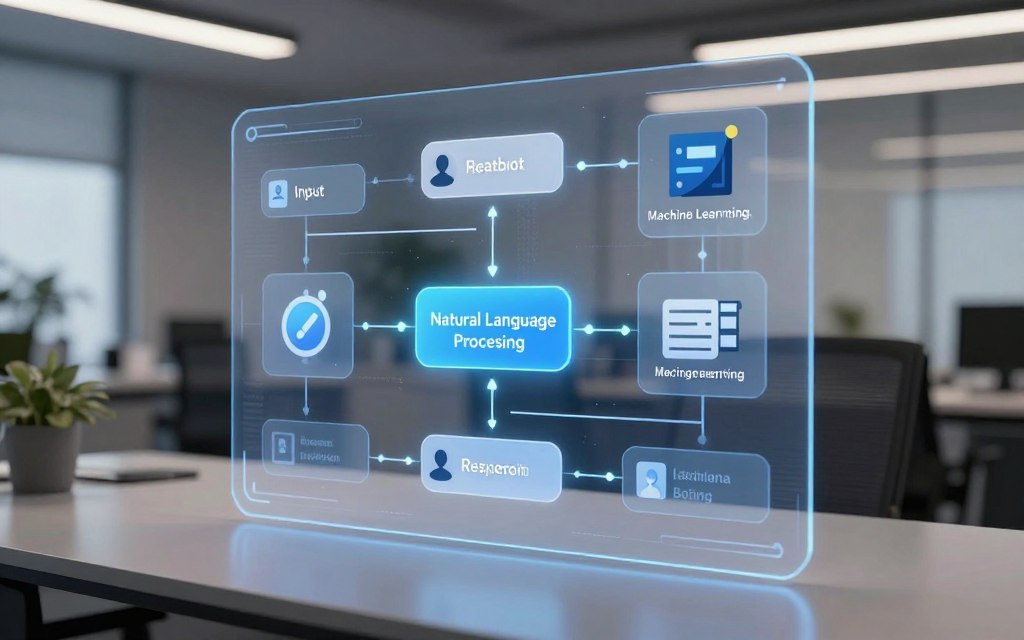
When a user sends a message, it goes to the processing core. This core is powered by Natural Language Processing (NLP) and Natural Language Generation (NLG) engines.
The NLP engine breaks down the message. It finds the intent, extracts important details, and checks the sentiment. The NLG engine then creates a response that fits the context. Together, they turn raw input into meaningful dialogue.
Integration APIs: Connecting to Data and Services
Chatbots become more valuable when they can access real information and perform actions. Integration APIs are key here. They connect the chatbot to other systems.
One big plus is seamless integration with existing tech. For example, a chatbot can get a customer’s order history from a CRM. It can also check inventory levels or orchestrate workflows by creating support tickets. This makes it more than just a simple responder.
The Role of Knowledge Bases and Training Data
The chatbot’s accuracy and relevance come from its knowledge. This knowledge comes from pre-trained datasets and custom organisational knowledge bases.
Many chatbots are pre-trained on billions of human conversations. This gives them a solid grasp of language and general knowledge. They are then fine-tuned with a company’s specific data. This includes chat logs, product manuals, and policy databases.
This mix allows the chatbot to give answers that are both natural and accurate for the business.
| Architectural Component | Primary Function | Key Features | Practical Example |
|---|---|---|---|
| User Interface Layer | Hosts the conversation channel | Web widgets, messaging apps, voice assistants | A chat window on an e-commerce product page |
| Processing Core (NLP/NLG) | Understands input and generates responses | Intent recognition, entity extraction, text generation | Interpreting “I need to reset my password” and creating a step-by-step reply |
| Integration APIs | Connects to external systems and data | CRM integration, payment gateways, database queries | Checking a delivery status by connecting to the courier’s tracking API |
| Knowledge Base & Training Data | Informs accurate and relevant answers | Pre-trained models, custom FAQs, historical interactions | Answering a technical support question using the latest product manual |
In summary, a strong chatbot architecture is a connected system. The interface captures the query, the core processes it, APIs retrieve data or actions, and the knowledge base ensures the response is informed and useful. When these parts work together, they create a powerful tool.
Categorising the Conversationalists: Different Types of Chatbots
The world of digital assistants is diverse, with several key types. Each type has its own way of working. Knowing these categories is key to picking the right tool for your needs. Chatbots are mainly split by how they handle language and conversations.
This way of sorting helps businesses and developers make better choices. For more on this, check out our guide on demystifying the different types and their.
Rule-Based (Declarative) Chatbots
Rule-based chatbots, also known as declarative chatbots, follow a set of rules. They use a decision-tree logic, where user inputs lead to specific responses. They are like digital flowcharts.
These systems work best in predictable, goal-oriented settings. They can’t change their script or learn from new chats.
Strengths and Typical Use Cases
The main strength of rule-based chatbots is their reliability. They give consistent, accurate answers within their limits. They are quick to set up and need less resources than AI models.
They are great for:
- FAQ automation: Answering simple customer questions.
- Form-based data collection: Helping users book appointments or fill out surveys.
- Simple customer support triage: Directing queries to the right human team based on user choice.
They’re perfect for guiding users to clear, specific outcomes.
AI-Powered (Predictive) Chatbots
AI-powered chatbots, on the other hand, use artificial intelligence to understand and create language. They don’t rely on strict rules. Instead, they figure out what the user means, even if they phrase it differently.
This lets them tackle open-ended, complex questions. They get better over time by learning from past chats.
Machine Learning and Neural Networks at Work
The heart of an AI chatbot is a machine learning model, often built on neural networks. Natural Language Processing (NLP) engines break down the user’s message to understand context, sentiment, and intent.
The system then picks the best response from its training data. This allows for advanced tasks like analysing sentiment in support chats or adapting product suggestions based on user behaviour.
The true power lies in their flexibility; they can handle conversations that don’t follow a strict path, making them seem more natural and human-like.
Hybrid Models: Combining the Best of Both Worlds
Many modern platforms now offer hybrid chatbot models. This mix of rule-based and AI-powered methods aims to use each type’s strengths while avoiding their weaknesses.
A hybrid chatbot might use rules for standard, high-volume queries with perfect accuracy. For more complex or unexpected questions, it switches to its AI engine.
This approach offers the best of both worlds. It ensures reliable efficiency for common tasks while providing the adaptive intelligence needed for complex problem-solving. Businesses get both controlled efficiency and creative problem-solving in one package.
| Feature | Rule-Based Chatbots | AI-Powered Chatbots | Hybrid Chatbots |
|---|---|---|---|
| Core Technology | Pre-defined decision trees & scripts | Machine Learning & Neural Networks | Combination of rules and ML algorithms |
| Flexibility & Learning | None; cannot learn from new data | High; continuously improves with data | Moderate; learns within a controlled framework |
| Handling Unstructured Queries | Poor; fails without exact keyword matches | Excellent; infers intent from context | Good; uses AI as a fallback for unknowns |
| Ideal Use Case | Structured FAQs, data collection, simple triage | Complex support, personalised recommendations, sentiment analysis | Enterprise customer service, e-commerce with diverse query types |
Chatbots in Action: Transformative Business and Consumer Applications
Conversational AI is changing how businesses talk to customers and make things run smoother. Chatbots are now a key part of digital plans. They make things easier by doing routine tasks, making interactions personal, and giving quick access to info and services.
Revolutionising Customer Service and Support
Customer service is where chatbots really shine. They handle lots of simple questions, freeing up people to deal with harder issues. This makes support faster and better for everyone.
24/7 Availability and Instant Responses
AI helpers never need a break. They answer questions anytime, which is great for businesses and customers all over the world. It means help is always just a message away.
Places like banks, phone companies, and travel sites use chatbots a lot. They can check your account, report lost cards, track orders, and update flight info without delay. This makes customers trust and feel loyal because they know help is always ready.
Streamlining E-commerce and Sales
Online shops use chatbots as personal shopping helpers and sales tools. They help visitors from the start, guiding them through buying things. This makes more people buy and spend more.
Key things chatbots do include:
- Personalised product recommendations based on what you’ve looked at and like.
- Answering quick questions about products, like size and delivery.
- Reminding you about items you left in your cart.
- Helping decide if you’re a good fit for a product and setting up meetings with sales teams.
These tools make online shopping feel like the real thing. They turn casual browsers into serious buyers.
Enhancing Internal Operations and HR
Chatbots aren’t just for customers. They also help inside companies. They act as a first point of contact for HR and IT stuff, cutting down on work for people.
Some ways chatbots help inside include:
- HR self-service for questions about policies, holidays, and benefits.
- IT support for things like password resets and software issues.
- Reminders for training, reviews, and checks.
- Helping new employees with important info and schedules.
By doing these tasks, companies can focus on bigger things. People in HR and IT are happier because they get answers faster.
Personal Assistants and Smart Home Control
For people, chatbots are like a friendly voice in their homes. They work with Amazon Alexa, Google Assistant, and Apple’s Siri. They handle daily tasks with just a voice or text command.
These smart helpers control lights, thermostats, and security. They set reminders, play music, give news, and even order groceries. They learn what you like and suggest things to make your life easier.
The line between business and home use of chatbots is getting smaller. A chatbot that helps you order pet food at home uses the same tech as one that helps a business manage its stock. This shows how adaptable and powerful conversational AI is.
| Application Domain | Primary Function | Key Benefit | Example |
|---|---|---|---|
| Customer Service | First-line support & query resolution | 24/7 availability, reduced wait times | Banking balance enquiries |
| E-commerce | Sales assistance & recommendation | Increased conversion, personalised shopping | Abandoned cart recovery |
| Internal Operations | Employee self-service | Operational efficiency, reduced admin burden | IT password reset |
| Consumer Smart Home | Task automation & control | Convenience, proactive assistance | Voice-controlled lighting |
As this shows, chatbots are used in many ways and are getting more important. They help with everything from simple tasks to complex workflows. They’re not just tools but partners in making things better for everyone.
Weighing the Impact: Advantages of Chatbot Adoption
Choosing to use a chatbot can bring many benefits. These benefits help with money and improve how we talk to customers. It’s important to know all the good things about chatbots.
Operational Efficiency and Cost Reduction
Chatbots are great at handling simple questions. They check order status, reset passwords, and give basic product info. This lets human staff deal with harder, more important issues.
This makes work more efficient and saves money. Companies can talk to lots of customers without needing more staff. Chatbots work all the time, even when we’re not there, which helps a lot.
Improved Customer Experience and Satisfaction
Today’s customers want quick answers. Chatbots give them instant help, no waiting. They’re always ready to help, any time.
Chatbots also offer personalised experiences. They know what you’ve talked about before and can suggest things. This makes customers feel special and keeps them coming back. It’s also a good way to find new customers.
Data Collection and Valuable Business Insights
Every chat with a chatbot is a chance to learn. They collect lots of data from these chats. This data is more than just what people ask.
Companies can use this data to find out what customers need and want. They can see how people feel about their service. This helps them make better products and marketing plans. Chatbots are like ears for businesses.
Scalability and Handling Peak Demands
One big plus of chatbots is how easily they grow. When lots of people want to talk at once, chatbots handle it without trouble. This keeps service good, even when it’s busy.
This is great for businesses that get busier at certain times. They can keep good service without the hassle of hiring extra staff. Chatbots grow with the demand.
In short, chatbots are a smart choice. They make work better, improve customer service, give useful data, and grow with your business.
Navigating the Challenges: Limitations and Ethical Considerations
To use chatbots wisely, we must first know their limits and the impact on society. They are powerful tools, but we must see their chatbot challenges. These include technical limits and ethical issues. Success comes from understanding and planning for these.
Understanding Limits: Context and Nuance
Traditional chatbots struggle with being too rigid. They follow set paths and fail with unexpected questions or complex language. Even advanced AI can misunderstand context, sarcasm, or subtle jokes.
Generative AI is another issue. It can give convincing but wrong answers, known as “hallucination.” Using these answers for important decisions or advice is risky. The main challenge is teaching machines to understand human conversation fully.

Data Privacy and Security Concerns
Every chatbot interaction creates data. This raises big questions about privacy, security, and following rules. Businesses must protect sensitive information and not leak it.
Generative AI adds risks. It can reveal training data, and using business or customer data in training can cause problems. To tackle these chatbot challenges, strong data management and clear privacy policies are needed.
Potential for Bias in Training Data
An AI chatbot’s bias comes from its training data. If this data has prejudices, the chatbot may repeat them. This can harm a brand’s reputation and lead to unfair results.
Checking training data for bias and using algorithms to detect it are key steps. It’s a big challenge that goes beyond just coding.
The Human Touch: Knowing When to Escalate
Even the most advanced chatbot has its limits. A key rule is knowing when to pass on a conversation to a human. Complex issues, emotional situations, or needs for deep knowledge often need a human touch.
Good systems have clear ways to escalate conversations. This makes users feel heard and supported, not stuck. The goal is to help, not replace humans. Chatbots handle simple tasks, letting humans focus on more important, empathetic work.
Dealing with these chatbot challenges is not a reason to avoid them. It’s a way to create reliable, effective, and lasting conversational AI solutions.
The Future of Chatbots: Trends and Developments to Watch
The next phase of chatbot evolution will be defined by three interconnected trends: emotional intelligence, multimodal interaction, and proactive personalisation. Moving beyond scripted replies, the future of chatbots is one of adaptive, context-aware digital partners. These systems will not just process requests but will understand intent, mood, and the wider situation.
This shift is powered by advances in generative AI and machine learning. It promises to make interactions more natural and valuable for users. Businesses that adopt these next-generation assistants will gain a significant edge in customer engagement and operational insight.
Increased Emotional Intelligence (EQ)
Future chatbots will move beyond logical query resolution. They will develop a form of Emotional Intelligence, or EQ. This means detecting subtle cues in language to gauge a user’s frustration, confusion, or satisfaction.
An empathetic chatbot can then adapt its tone and response strategy. For a stressed customer, it might use more reassuring language and prioritise clarity. For an inquisitive user, it might offer more detailed explanations. This EQ is built on sophisticated sentiment analysis models within the NLP core.
Generative AI plays a key role here. It allows the bot to formulate responses that are not just correct, but also contextually and emotionally appropriate. The result is a conversation that feels more supportive and human-centric, building greater trust.
Multimodal Interactions: Voice, Vision, and Beyond
The classic text-based chat window is expanding. The future is multimodal, integrating voice, sight, and even gesture. Users will converse naturally via speech, just as they do with smart speakers. The chatbot will analyse tone, pace, and inflection for deeper understanding.
Integration with computer vision is another leap forward. A user could show a chatbot a photo of a broken appliance. The bot can identify the model, access a knowledge base, and guide the user through repair steps visually. This blends conversational AI with powerful visual recognition.
These multimodal interfaces make technology more accessible and intuitive. They allow for richer, more efficient problem-solving. They turn the chatbot into a versatile assistant capable of interpreting the world much like we do.
Hyper-Personalisation and Proactive Assistance
The ultimate goal is a shift from reactive to proactive service. Using data analytics and user history, chatbots will anticipate needs before a question is asked. This is hyper-personalisation in action.
Imagine a travel chatbot that knows your preferences. It might proactively alert you to a flight delay and automatically rebook you on the next available option. A banking bot could notice unusual spending patterns and instantly send a verification query to prevent fraud.
This requires seamless integration with customer data platforms and other business systems. The chatbot acts as an intelligent layer, using insights to deliver timely, relevant assistance. It transforms the user experience from one of seeking help to receiving curated support.
| Trend | Core Idea | Key Technology Enabler | Example Use Case |
|---|---|---|---|
| Emotional Intelligence (EQ) | Understanding and adapting to user emotion and context. | Advanced Sentiment Analysis & Generative AI | A support bot calming a frustrated customer with empathetic language and clear steps. |
| Multimodal Interactions | Moving beyond text to include voice, images, and video. | Speech Recognition & Computer Vision APIs | A user verbally asking a bot for help, then showing a video of an issue for visual diagnosis. |
| Hyper-Personalisation | Anticipating user needs and acting proactively. | Predictive Analytics & Real-time Data Integration | A retail bot suggesting a replacement for a frequently purchased item that is nearly out of stock. |
Together, these trends chart a course for chatbots to become indispensable, intuitive partners. The focus moves from simple task completion to fostering meaningful, efficient, and personalised engagement. This is the exciting trajectory for the future of chatbots.
Conclusion
Chatbots have come a long way from their simple beginnings. Now, they are smart partners that change how businesses work.
Using chatbots brings big benefits. Companies see better efficiency, happier customers, and gain insights from chats. Modern virtual agents are key to this digital shift.
Even with challenges like understanding nuances and ethics, chatbots are getting better. Smart businesses see chatbots as essential for staying ahead.
Platforms like IBM watsonx offer the strong base needed for secure, smart virtual agents. Investing in these solutions pays off and keeps companies competitive in an automated world.
The talk with technology is only starting. Adopting advanced virtual agents is a must for any business wanting to lead in digital customer service.
FAQ
What exactly is a chatbot?
A chatbot is a software that uses artificial intelligence to talk to people online. It acts like a digital helper, understanding what you say or type and then responds. Today’s chatbots are smarter, able to handle more complex questions than before.
What is the difference between a basic chatbot, an AI chatbot, and a virtual agent?
A basic chatbot follows set rules and is good for simple tasks. An AI chatbot uses advanced tech to understand and learn from conversations. A virtual agent is a top-level AI assistant that can do complex tasks and work across different platforms.
How have chatbots evolved from their early beginnings?
Chatbots started with simple programmes like ELIZA and PARRY in the 1960s and 1970s. These early bots used patterns to mimic talk. Now, with AI, chatbots can learn and understand conversations much better.
How do modern chatbots understand and generate human language?
Modern chatbots use a few key technologies. Natural Language Processing (NLP) helps them understand what you say. Natural Language Generation (NLG) makes their responses sound natural. Dialog Management keeps track of the conversation, making sure answers are relevant.
What are the key components that make up a chatbot system?
A chatbot system has a few main parts. There’s the User Interface, like a website widget. Then there’s the Processing Core with NLP and NLG engines. It also has Integration APIs to connect to other systems and a Knowledge Base to learn from.
What are the main types of chatbots available today?
There are mainly three types of chatbots. Rule-Based chatbots follow set paths and are great for FAQs. AI-Powered chatbots adapt to new questions. Hybrid chatbots mix both for a balanced approach.
What are some practical business applications for chatbots?
Chatbots are useful in many ways. They help with customer service, e-commerce, and even internal operations. They can also act as personal assistants in devices like Amazon’s Alexa.
What are the main business advantages of implementing a chatbot?
Using a chatbot can make your business more efficient and save money. They offer instant support, gather valuable data, and can handle more customers without needing more staff.
What are the major limitations and ethical concerns with chatbot technology?
Chatbots face challenges like understanding complex conversations and handling sensitive topics. There are also concerns about data privacy and bias in their training data. It’s important to have clear ways for users to talk to real people when needed.
What future trends are shaping the development of chatbots?
Future chatbots will be more emotional and empathetic. They will use different ways to communicate, like text, voice, and images. They will also get better at understanding what you need before you even ask.

 By
By