


AI chatbots have become essential, not just a novelty. Their use has grown by 92% from 2019. Experts at Gartner say they will handle 85% of customer service by 2028. Now, users expect smart, helpful chats.
But, many find chatbots frustrating. Conversations often stop, answers seem generic, and efficiency is hard to find. The secret is that making the most of chatbots is a learnable skill. It’s about clear communication and smart planning.
This guide offers clear, useful tips to improve your AI chatbot interactions. You’ll learn how to go from simple questions to smart AI teamwork. By mastering these skills, you’ll unlock the full power of this game-changing tech.
The idea becomes more practical when you connect it to microsoft’s ai chatbot what you need in a real conversational-AI workflow.
Understanding What Your Chatbot Can and Cannot Do
Chatbots have grown from simple FAQ tools to advanced conversational agents. They are now key in customer and business operations. In fact, they handle about 65% of business-to-consumer communications. It’s vital to know their limits to use them well.
When starting with a chatbot, list the problems you want to solve. Choose the channels where it can help the most. This planning helps you use the chatbot effectively.
The Core Functions of Modern AI Chatbots
Today’s chatbots are great at several things. They help make things more efficient and improve service. Their main jobs are automation, making things easy to get, and handling data.
- 24/7 Availability and Instant Response: AI chatbots work all the time, answering questions day or night quickly.
- Handling Routine and Repetitive Queries: They’re good at answering common questions, booking things, and giving updates.
- Data Processing and Retrieval: Chatbots can quickly find information in big databases or documents.
- Multi-Channel Engagement: A good chatbot works on websites, messaging apps, and social media, giving a consistent experience.
These jobs make chatbots great for automating tasks that follow a pattern. They free up people for more complex tasks.
Recognising Common Limitations and Misconceptions
AI chatbots are not perfect. A big mistake is thinking they think like humans. They work based on patterns and data they’ve been trained on. Knowing their limits is key for a successful use.
Some main limits are:
- Limited Context Retention: Chatbots can remember conversations, but not forever or across different topics without special programming.
- Struggle with Nuance and Ambiguity: They can find it hard to understand sarcasm, idioms, or vague requests.
- Inability to Handle Truly Novel Situations: If a question is too new, chatbots might not know how to answer it.
- Lack of Genuine Understanding: They talk based on data, not real understanding.
It’s important to plan how to use chatbots wisely. Use them for simple tasks and hand over complex ones to humans. This way, you avoid disappointment and get the most from your chatbot.
Knowing what chatbots can and can’t do is the first step in using them well. It helps you use them where they’re most helpful and avoid expecting too much.
Defining Clear Goals for Every Interaction
The difference between a casual chat and a productive session with your chatbot is intentionality. Knowing what your AI can do is the first step. Deciding what you want it to do for you is the leap that transforms random queries into targeted, results-driven conversations. This section guides you through setting clear, actionable objectives for every interaction, ensuring your time with AI yields tangible value, whether for personal projects or core business functions.
How to Set Specific and Achievable Objectives
Effective goal-setting starts with specificity. Vague prompts like “help with marketing” lead to vague, often unusable outputs. Instead, frame your objective with a verb and a defined outcome. For personal use, this could be “Draft a structured outline for a 1000-word article on sustainable gardening” or “Summarise the key arguments from these three research papers on renewable energy.”
In a business context, this process is formalised. Best practice starts by defining the chatbot’s primary role—is it for customer support, lead generation, or internal data analysis? Once its mission is clear, you can outline specific, measurable goals. As guidance on Key Performance Indicators (KPIs) suggests, these should be metrics you can track.
Common business KPIs for chatbots include:
- Improving lead generation conversion rates by a target percentage.
- Shortening average customer issue resolution time.
- Increasing qualified bookings for sales demos.
- Reducing the volume of repetitive queries handled by human staff.
Establishing these objectives upfront provides a benchmark for success. It turns an open-ended tool into a focused solution for setting chatbot goals that directly impact your bottom line or productivity.
Aligning Your Expectations with AI Realities
The most meticulously crafted objective can lead to frustration if it ignores the operational boundaries of the technology. This is where your goals must be tempered by the “AI realities” discussed earlier. A brilliant goal for a creative brainstorming session is perfectly aligned. A goal that requires the AI to access real-time, proprietary financial data to predict next week’s stock market is not.
Aligning expectations means framing your ambitions within the chatbot’s known capabilities. If you know your AI’s knowledge cut-off date is 2023, your research goals should focus on information up to that point. If you understand its limitations with highly nuanced, emotional language, you would not set a goal for it to perform delicate conflict mediation.
The most powerful AI strategy pairs human ambition with machine practicality.
This alignment is critical for satisfaction. By setting chatbot goals that are both ambitious and achievable within the AI’s scope, you avoid the disappointment of unrealistic demands. You create a framework for productive collaboration, where the machine’s strengths are fully leveraged to meet your clearly defined needs. This disciplined approach forms the essential foundation upon which all advanced interaction strategies are built.
Mastering the Art of Prompt Engineering
Effective communication with AI relies on a special skill called prompt engineering for chatbots. It’s about crafting instructions that guide AI to give accurate and useful answers. While setting goals tells AI what you want, prompt engineering shows how to ask for it. This skill turns vague questions into clear answers, as shown in the guide to mastering the art of prompt engineering.
Principles of Writing Effective Queries
To get top-notch results, follow a few key rules. These are like the grammar rules for talking to AI.
Using Specific and Unambiguous Language
Good prompt engineering for chatbots means being precise. Vague questions get vague answers. Be clear and simple, avoiding jargon unless sure the AI knows it.
Instead of asking many things at once, aim for one clear goal. This helps the AI understand what you really need.
- Instead of: “Tell me about marketing.”
- Try: “List five low-cost digital marketing strategies for a new local bakery, focusing on social media.”
The second prompt is clear about what you need, leaving no doubt.
The Critical Role of Providing Context
An AI doesn’t know your specific situation. That’s where prompt engineering for chatbots comes in. Context helps the AI tailor its answers.
Context acts as a lens, focusing the AI’s vast knowledge on your specific problem.
For example, asking for “help with a budget” is vague. Saying, “I need a monthly budget for a freelance graphic designer with irregular income, focusing on tax savings,” gives the AI the right context. It can then give a relevant plan instead of a generic one.
Practical Examples: Transforming Vague Prompts into Productive Ones
Let’s see how these principles work in practice. The process often needs to be repeated.
Example 1: Request for Code
Vague Prompt: “Write some Python code.”
Refined Prompt: “Write a Python function named ‘clean_email’ that takes a string input. It should remove all spaces, convert the text to lowercase, and return the result. Include a docstring explaining the function.”
The refined prompt is clear about the language, function name, input, operations, and documentation.
Example 2: Request for Content Ideas
Vague Prompt: “Give me blog topics.”
Refined Prompt: “Generate five blog post title ideas for a UK-based small business accountant. The topics should advise clients on preparing for the 2024/25 tax year end. The tone should be professional but approachable.”
This prompt is specific about the audience, profession, timing, and tone, giving useful ideas.
These examples show the basics of prompt engineering for chatbots. Start with your basic need, then add details, clarity, and context. This process is key to making the AI a valuable tool.
How to Get the Most Out of Your Chatbot: Advanced Interaction Strategies
The true power of AI chatbots is in the ongoing dialogue, not just the first question. By mastering advanced chatbot strategies, you can turn a simple query into a deep, collaborative session. This way, you guide the AI to uncover more insights and accurate results.

Employing Strategic Follow-up Questions
Effective dialogue builds momentum. Instead of treating each question as separate, use follow-up questions to dig deeper. Think of it as a conversation with a knowledgeable colleague.
For example, after an initial answer, ask for specific examples or a comparison. You can also ask for the reasoning behind the answer. To keep the conversation flowing, introduce slight delays by breaking your requests into chunks. Give one clear instruction, wait for the AI’s response, then ask your next logical question.
This methodical back-and-forth often provides more detailed and useful information than a single, long prompt.
Leveraging Conversational Memory and Thread Context
Most modern chatbots have a short-term memory called a context window. This lets them refer to your entire conversation, avoiding repetition.
Use pronouns like “it” or “that idea” in later prompts to reference previous answers. This is great for tasks like drafting documents or refining code. By building on previous exchanges, you create a clear narrative for the AI to follow, making your work more efficient.
Implementing Effective Feedback for Better Results
Providing real-time feedback is a key strategy often overlooked. Chatbots learn from your corrections and preferences during a session. A simple, polite correction is more effective than starting over.
Use phrases like:
- “That’s not quite what I meant. Let’s focus instead on…”
- “Can you revise the third paragraph to be more concise?”
- “The data point about X seems incorrect. Please recheck and use source Y.”
This practice of “clarify and correct when needed” trains the interaction. It tells the AI what to adjust, leading to better responses right away. This feedback loop improves your chatbot’s performance over time.
By using these strategies—strategic questioning, context-aware dialogue, and constructive feedback—you can transform your interactions. These advanced strategies unlock your chatbot’s full power as a responsive and adaptable partner.
Streamlining Tasks with Chatbot Integration
Modern chatbots do more than just answer questions. They can now take action, making them key to boosting productivity. This change from passive to active tools brings big efficiency gains. The secret to unlocking this is through smart chatbot task automation and integration with your current software.
When an AI assistant links up with CRM systems, contact centre software, and apps like Microsoft Teams, it becomes more than just a tool. It becomes a central point for executing commands, getting data, and managing tasks. This integration brings together human ideas and machine action.
Automating Repetitive Administrative Work
One big advantage of integration is automating boring, time-wasting tasks. By linking chatbots to backend systems, you can trust them with routine jobs. This frees up people to focus on more complex, strategic tasks.
Here are some examples of tasks that can be automated:
- Appointment Scheduling: A chatbot can book meetings, send reminders, and handle changes on its own, even when you’re not around.
- Lead Qualification: With a CRM like Salesforce, a chatbot can talk to website visitors, ask questions, and score leads. It then logs the data automatically.
- Data Entry and Summarisation: Chatbots can pull out important info from forms or chats and fill in databases. This makes sure data is accurate and consistent, without needing someone to type it out.
This level of chatbot task automation speeds up work and cuts down on mistakes. It makes sure important actions, like adding a new contact to a list, happen right away without anyone forgetting.
Using Chatbots for Enhanced Research and Data Analysis
Chatbots are also great at helping with research, sorting through lots of info faster than a person. They can access data, analyse it, and give you a quick summary.
For example, you can give a chatbot a long report or document to summarise. Advanced chatbots can even search the web and give you a detailed overview on any topic.
The table below shows how chatbots can change research compared to doing it manually:
| Research Activity | Traditional Manual Method | Integrated Chatbot Assistance |
|---|---|---|
| Competitor Analysis | Hours of manual website review and note-taking. | Instant synthesis of publicly available data into a comparative report. |
| Document Review | Reading entire PDFs to find specific clauses or data points. | Direct querying for summaries, specific terms, or quantified data. |
| Market Data Gathering | Searching multiple sources and compiling figures manually. | Automated aggregation of the latest statistics and trends from verified sources. |
To make this work, the chatbot needs to connect with your knowledge bases, document systems, and other tools. This makes the AI a central point for information gathering and analysis. It makes deep insights easy to get through simple chat.
Effective chatbot task automation means creating a unified digital team. By adding smart assistants to your main systems, you make your work environment more responsive, efficient, and insightful.
Measuring Success and Refining Your Approach
Measuring chatbot success is an ongoing task. It starts with setting goals and then evolves as you track trends and meet changing user needs. This process turns a useful tool into a strategic asset, keeping your chatbot relevant and effective.
A good approach mixes numbers with insights. It involves regular checks to spot patterns, find what frustrates users, and uncover benefits. This focus leads to continuous improvement.
Key Performance Metrics to Monitor
To measure performance well, track a mix of metrics. These show how well your chatbot understands and solves problems. Regular tracking is key to measuring chatbot success.
Focus on these core areas:
- Resolution Rate: The percentage of conversations where the chatbot fully addresses the user’s query without human escalation. A high rate indicates strong knowledge base coverage and effective prompt design.
- User Satisfaction (CSAT): Often gathered via post-chat surveys. This direct feedback is invaluable for understanding the user’s emotional experience and perceived helpfulness.
- Average Conversation Length: While complex tasks may require longer dialogues, an unusually high average might signal confusion or inefficient problem-solving.
- Escalation Frequency: Tracks how often conversations are transferred to a human agent. Analysing the topics that trigger escalation highlights critical knowledge gaps.
- Fallback Rate: Measures how often the chatbot responds with “I don’t understand.” This is a direct signal for prompt engineering or knowledge base updates.
The table below summarises these key metrics, their ideal trends, and the primary insights they offer for refinement.
| Performance Metric | What It Measures | Ideal Trend | Actionable Insight |
|---|---|---|---|
| Resolution Rate | Ability to solve issues independently | Steady increase | Shows where knowledge is strong or weak |
| User Satisfaction (CSAT) | Perceived helpfulness & experience | High & stable | Highlights emotional pain points or delights |
| Avg. Conversation Length | Efficiency of interaction | Appropriate to task | Flags confusing flows or verbose responses |
| Escalation Frequency | Dependence on human support | Gradual decrease | Identifies complex topics needing training |
| Fallback Rate | Rate of “I don’t understand” responses | Sharp decrease | Directs prompt engineering efforts |
A Process for Continuous Testing and Improvement
Data alone is not enough. You need a structured, repeatable process to act on it. This cycle of testing, learning, and updating ensures your chatbot adapts and grows smarter over time.
Follow this four-step framework for continuous improvement:
- Analyse Conversation Logs Weekly: Go beyond numbers. Read actual dialogues to find where misunderstandings occur. Look for user rephrasing, signs of frustration, or creative uses you hadn’t anticipated. This qualitative review is where major insights live.
- Test with New and Edge-Case Queries: Regularly challenge your chatbot. Pose questions just outside its known scope. Use these tests to identify gaps in its knowledge base or logic. This proactive step prevents user frustration.
- Refine Prompts and Knowledge Base: Use your findings to update the system. Clarify ambiguous instructions, add new information to the knowledge base, and adjust response templates for better clarity. Remember, your initial goals may shift as new benefits emerge.
- Monitor Impact and Repeat: After making changes, closely watch the relevant metrics for the next week. Did the resolution rate improve? Did fallbacks decrease? This closes the loop, turning insights into verified improvements and starting the cycle anew.
This process turns monitoring from a passive activity into an engine for growth. By staying up to date with user needs and systematically refining the knowledge base, you ensure your chatbot’s value compounds, making every interaction more productive than the last.
Tailoring the AI to Your Personal or Business Needs
Customising AI chatbots makes them essential for both personal and business use. A generic approach rarely works well. The real benefit comes from tailoring the AI to meet your specific needs.
There are two main steps to customise AI chatbots. First, set up the initial parameters for its operation. Then, refine its performance through ongoing dialogue. This turns a generic tool into a personal partner.
Customising Settings for Optimal Output
The first step in creating a tailored chatbot is its initial setup. Modern platforms offer a lot of control, even for those without coding skills. This makes it easy to design the user experience without needing a developer.
Customisation should cover both technical and user aspects. You might choose a specific AI model, like GPT-4 for creative tasks or Claude Sonnet for analytical tasks. Picking the right engine is key.
The chatbot’s personality and tone are also critical. This is where you add your brand’s identity. Whether your voice is professional or casual, it should match your brand.
Here’s a table showing key areas for customisation and their effects:
| Customisation Area | Technical Consideration | User Experience Impact |
|---|---|---|
| AI Model & Parameters | Selection of base model (e.g., GPT-4, Claude), temperature setting for creativity. | Determines the depth, accuracy, and style of the information provided. |
| Personality & Tone | Pre-written greeting messages, response style guidelines, vocabulary rules. | Creates a consistent, on-brand voice that users can recognise and trust. |
| Knowledge Base Integration | Connection to internal documents, product databases, or FAQ repositories. | Enables the chatbot to provide specific, relevant answers about your products or services. |
Good design goes beyond just working. It makes interactions feel like helpful conversations. Setting these parameters correctly from the start saves a lot of time later.
The Benefits of Progressive Training and Adaptation
Setting up the chatbot is just the start. The real power comes from progressive training. This is when the AI learns and adapts from every interaction.
For individuals, this means the chatbot learns your preferences. It will start answering questions in the way you prefer. If you correct its language, it will use your preferred terms. This creates a tool that fits your work style perfectly.
For businesses, this concept grows into a knowledge base. This is a database the chatbot uses. Every correct answer strengthens the knowledge base. Every incorrect answer gives you a chance to teach the system.
This continuous adaptation offers clear advantages:
- Increasing Accuracy: Over time, the chatbot’s responses become more precise and relevant to your specific context.
- Reducing Repetition: It learns from past conversations, avoiding redundant questions and providing faster solutions.
- Scaling Expertise: The collective knowledge of your team and customer interactions gets codified into an always-available resource.
Think of it as mentoring a new team member. You provide clear guidelines, then offer constructive feedback on their work. Gradually, they become more autonomous and proficient. The same principle applies to shaping your AI assistant’s capabilities and output.
Ultimately, tailoring your chatbot is an investment. It requires thoughtful setup and active participation. The return is a dynamic tool that evolves with your needs, delivering increasingly valuable and personalised support.
Maintaining Security and Privacy Best Practises
AI chatbots are convenient but need careful handling to protect your data. Always be cautious when using them. This means knowing what happens to your data and following chatbot security best practises.
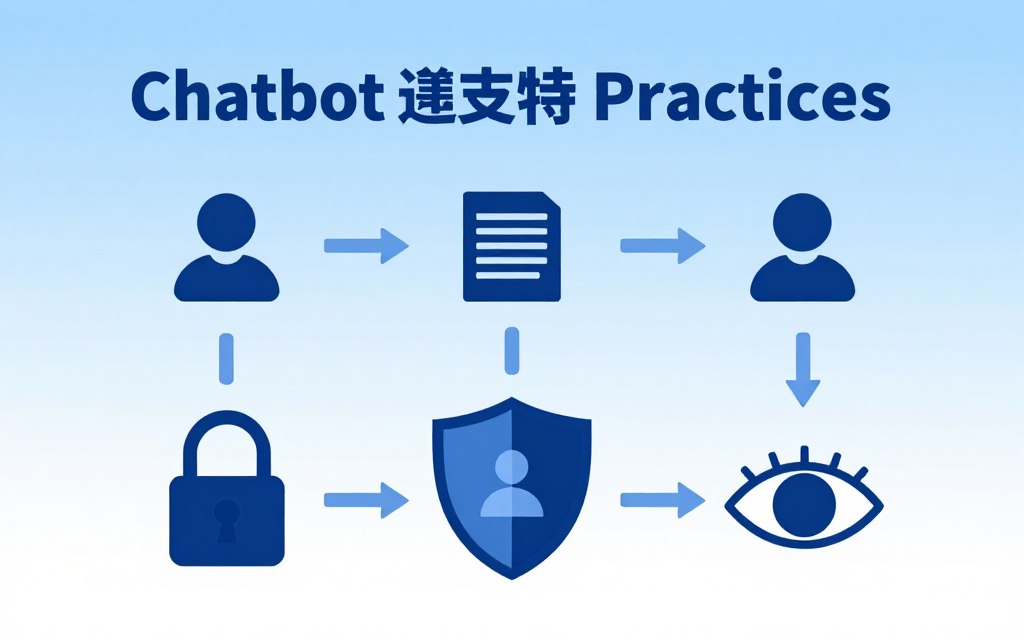
Protecting Sensitive Data During Interactions
Start by being careful with what you share. Never give out personal details like your full national insurance number or home address. Also, keep confidential business data and unpublished ideas safe.
Follow the rule of data minimisation. Only share what’s needed for the chatbot to help you. For sensitive data, use private platforms that promise your data won’t be shared.
Make sure your team knows what’s okay to share with AI tools. Teach them about data protection regularly. This makes it a habit.
Identifying and Mitigating Potencial Security Risks
Knowing about threats helps you stay ahead. A big risk is your chat data being used without your say-so. Another is data breaches because of poor storage or sharing.
When using third-party Large Language Model (LLM) services, check their data policies. Ask if they encrypt your data and how long they keep it. Who can access it is also important.
To stay safe, choose trusted providers and ask for clear policies. Look for those that follow GDPR and CCPA. Regular updates are also key to fixing security issues.
| Risk Type | Description | Potential Impact | Recommended Mitigation |
|---|---|---|---|
| Data Used for Model Training | Your inputs are logged and used to train the public AI, potentially exposing sensitive patterns. | Unintended public disclosure of confidential information. | Use enterprise plans with data isolation; explicitly opt out of training where possible. |
| Insecure Data Storage | Conversation logs are stored on servers with weak encryption or access controls. | Data breaches leading to theft of personal or business information. | Select providers with strong encryption (AES-256) and clear data retention policies. |
| Non-Compliance with Regulations | The provider’s operations do not align with legal frameworks like GDPR or CCPA. | Legal liability, fines, and loss of user trust for your organisation. | Verify the provider’s compliance certifications and data processing agreements. |
| Insider Threat / Misuse | Employees accidentally or deliberately sharing sensitive data via chatbots. | Internal data leaks and compromised intellectual property. | Implement strict usage policies, access logs, and ongoing staff training programmes. |
Strong chatbot security best practises start with making informed choices and constant monitoring. By understanding risks, asking the right questions, and setting clear rules, you can use AI safely.
Future-Proofing Your Skills: Emerging Chatbot Trends
To stay ahead in AI chatbots, look beyond today’s tech. The future holds exciting trends. These changes will turn chatbots from simple tools to proactive partners. It’s key to grasp these innovations for a competitive edge.
Innovations in AI and Natural Language Processing
Recent NLP breakthroughs have changed chatbots. They now understand context, sarcasm, and subtle meanings better. This makes conversations feel natural and productive.
Another big step is multimodal AI. Systems like Google’s Gemini can handle text, images, and audio at once. Imagine asking a chatbot to explain a product schematic or analysing a sales call. This mix of data enriches interactions.
These advancements also lead to hyper-personalisation. Chatbots now tailor responses based on your history and preferences. They even detect your emotional tone. This makes interactions more adaptive and relevant to you.
The Growing Synergy Between Human and Machine Collaboration
The biggest change is moving from simple bots to AI co-pilots. The aim is to enhance human abilities, not replace them. This partnership makes teams more effective, with machines handling data and humans focusing on strategy and empathy.
Real-world examples are already here. Revenue.io’s Agent Assist listens to sales calls and offers live help. It suggests rebuttals and highlights important customer signals. This boosts performance dramatically.
This collaborative approach is expanding across various fields:
- Customer Service: AI suggests articles and drafts while agents manage relationships.
- Creative Work: Chatbots generate ideas, which humans then refine.
- Data Analysis: AI summarises reports and suggests insights, with humans making the final decisions.
The future of chatbots is in this partnership. By using tools as real-time assistants, your skills will grow with the tech. Understanding these future chatbot trends keeps you ahead in an AI-enhanced world.
Conclusion
Getting the most from your chatbot takes time and practice. It’s about setting clear goals and improving how you interact with it. This way, you can make the most of it.
The key is to see your chatbot as a partner, not just a tool. Good AI communication means guiding the chat with clear intentions. This makes the conversation more effective.
We’ve looked at important techniques to improve your chatbot use. From simple prompts to complex strategies, each helps make your chats more productive. This leads to better results.
Start using these tips every day. Begin by setting clear goals for each chat. Then, use the chatbot for more complex tasks like research or organising data.
By improving your AI communication skills, you’ll get things done faster. You’ll also find insights you might have missed. This skill is key for success in both work and life.
Start improving your AI interactions today. You’ll unlock new levels of efficiency and creativity. It’s all within your reach.
FAQ
What are the most common mistakes people make when using an AI chatbot for the first time?
Many new users have high hopes for chatbots. They expect them to think like humans. But, they often ask vague questions and don’t give enough context.
They also expect the AI to remember everything forever. Not setting a clear goal for the chat can make it go off track.
How can I write a better prompt to get a more useful answer from ChatGPT or Claude?
To get better answers, be clear and specific. Instead of “write about marketing,” say “Draft a 300-word email welcoming new subscribers to a sustainable fashion brand’s newsletter, focusing on their first-order discount.”
Always give context. Mention your role, the format, tone, and any important points. This helps the AI give a better answer.
Can I use an AI chatbot to handle sensitive business or customer data?
Be very careful with sensitive data. Don’t share personal info, business secrets, or intellectual property in public chatbot sessions.
For secure use, choose enterprise-grade solutions like Microsoft Copilot. Always check the vendor’s data privacy and storage policies.
What does ‘chatbot integration’ mean, and how can it streamline my work?
Integration connects your chatbot to other software, like Salesforce or Microsoft Teams. This automates tasks.
For example, a chatbot can quickly access a customer’s order history. It can also log leads into your sales pipeline. This makes your work flow smoother and faster.
How do I measure if my business’s chatbot is actually performing well?
Use Key Performance Indicators (KPIs) to check how well your chatbot is doing. Look at metrics like first-contact resolution rate and user satisfaction scores.
Also, check the average conversation length and how often users need human help. Use these insights to improve your chatbot over time.
What is ‘progressive training’ and how can it personalise a chatbot for my company?
Progressive training shapes an AI’s answers through interaction and feedback. For your business, build a knowledge base with product manuals and guides.
As the chatbot uses this data and gets feedback, it becomes more tailored to your domain. You can also make its tone match your brand, making interactions more coherent.
What are the emerging trends in AI chatbots that I should be aware of?
The field is rapidly advancing. Multimodal AI models can now process images, audio, and video, leading to richer interactions.
Natural Language Processing (NLP) is also improving, allowing for better understanding of context and emotion. AI is becoming a real-time co-pilot, helping with creative tasks, data analysis, and customer service.


 By
By