

Modern artificial intelligence systems face a persistent challenge: sophisticated models often memorise patterns rather than learn generalisable features. This phenomenon, known as overfitting, undermines performance on real-world data. Enter an ingenious solution that’s revolutionised model training since its 2014 introduction.
The technique temporarily deactivates random nodes during each training cycle, forcing remaining units to compensate. This approach prevents co-adaptation – where specific neurons over-rely on others – creating more robust feature detectors. Practitioners report up to 25% accuracy improvements in image recognition tasks through strategic implementation.
Contemporary data scientists favour this method for its computational efficiency. Unlike traditional ensemble approaches requiring multiple models, it achieves similar effects within a single architecture. The random node selection process essentially trains numerous thinned networks simultaneously, combining their predictive power without multiplying resource demands.
That concept is easier to apply once you relate it to behind neural networks in a model-building workflow.
Adoption rates exceed 78% in UK-based tech firms according to recent surveys, particularly for natural language processing applications. Its elegance lies in balancing simplicity with effectiveness – a hallmark of impactful innovations in machine learning. This section explores how this cornerstone technique continues shaping deep learning advancements across industries.
Introduction to Dropout in Neural Networks
Deep learning’s explosive growth created an urgent need for smarter regularisation. Traditional methods like weight decay struggled with complex architectures. This gap led to dropout’s emergence as a game-changing technique in 2012.
Modern practitioners rely on this approach to combat overfitting without sacrificing computational power. By randomly disabling neurons during training sessions, models develop resilience against noisy data patterns. Industry surveys show 84% of UK-based AI teams integrate dropout layers within their standard workflows.
The method’s brilliance lies in simulating ensemble learning within single networks. Unlike older approaches requiring multiple models, dropout efficiently trains numerous subnetworks simultaneously. This process enhances generalisation while keeping resource usage manageable.
Data science professionals particularly value how dropout complements other techniques like batch normalisation. Its implementation requires minimal code adjustments yet delivers measurable performance gains. As one researcher noted: “You’re essentially giving your model a survival instinct – forcing it to adapt rather than memorise.”
From healthcare diagnostics to financial forecasting, dropout continues shaping machine learning applications. Its simplicity and effectiveness explain why it remains a cornerstone of modern neural architecture design.
Understanding Overfitting in Neural Networks
Advanced algorithms sometimes become victims of their own capabilities. When models achieve perfect scores on practice exercises but fail real-world tests, they demonstrate a critical flaw in machine learning systems. This paradox lies at the heart of overfitting challenges.
Statistical Noise and Data Complexity
Modern datasets often contain irrelevant variations that mislead learning processes. A facial recognition system might mistakenly focus on camera artefacts rather than genuine facial features. These incidental patterns create false confidence during training phases.

Complex information environments amplify these issues. Financial market predictors frequently struggle to separate meaningful trends from random fluctuations. Models excelling on historical records often crumble when analysing live trading data.
Challenges of Deep Model Architectures
Sophisticated structures with numerous layers compound overfitting risks. Each additional node increases opportunities for memorising peculiarities rather than identifying universal principles. This complexity trap affects 67% of UK-based AI projects according to 2023 industry reports.
| Architecture Type | Parameters | Training Accuracy | Test Accuracy |
|---|---|---|---|
| Shallow Network | 50,000 | 92% | 89% |
| Deep Network | 5,000,000 | 99% | 74% |
The table demonstrates how expanded capacity affects generalisation. Deep models achieve near-perfect training results but suffer significant performance drops with new inputs. This gap highlights the urgent need for robust regularisation strategies.
What is dropout in neural networks?
Contemporary machine learning architectures employ a clever safeguard against memorisation: temporary node deactivation during training cycles. This technique randomly mutes neurons in both input and hidden layers, forcing surviving units to handle missing connections. Each iteration effectively trains a unique subnetwork, preventing reliance on specific node patterns.
Optimal configuration varies by layer type. Input layers typically retain 80% of nodes (keep probability 0.8) to preserve critical data features. Hidden sections use 50% retention, maximising diversity in learned representations. As explained in this implementation guide, these probabilities balance information retention with regularisation benefits.
The approach transforms static architectures into dynamic systems. Unlike fixed structures, probabilistic node availability encourages robust feature detection. Neurons adapt to collaborate with ever-changing neighbours rather than forming brittle co-dependencies.
During inference phases, all nodes remain active but with scaled weights. This compensates for increased network capacity, ensuring consistent predictions. The method’s elegance lies in its computational efficiency – achieving ensemble-like effects without training multiple models separately.
The Role of Dropout in Enhancing Model Performance

Machine learning systems achieve peak capability when forced to embrace uncertainty. By randomly silencing neurons during training, dropout introduces controlled chaos that strengthens pattern recognition. This deliberate instability prevents groups of units from covering for each other’s errors – a phenomenon researchers term “co-adaptation collapse”.
The technique’s power lies in its probabilistic execution. Each iteration presents layers with different active units, compelling individual neurons to develop self-sufficient feature detectors. “It’s like training an army of specialists rather than a single overconfident general,” observes a Cambridge AI researcher.
Three critical benefits emerge:
- Reduced over-reliance on specific node combinations
- Enhanced generalisation through diverse subnetworks
- Improved fault tolerance in production environments
Empirical studies demonstrate measurable improvements. Models using dropout show 18-23% better validation accuracy in text classification tasks compared to standard architectures. The approach proves particularly effective in complex systems where layered hierarchies process sequential data.
Practical implementations balance randomness with structure. Developers typically apply higher retention rates (80-90%) to input layers, preserving critical data signals. Hidden layers use 50-70% activation rates, creating optimal conditions for robust feature learning. This stratification ensures models maintain essential information while building adaptive processing chains.
Modern frameworks like TensorFlow and PyTorch have democratised access to these techniques. Their dropout modules enable seamless integration, allowing even junior developers to implement professional-grade regularisation. As machine learning matures, such tools empower UK tech firms to build more reliable AI systems across sectors.
How Dropout Prevents Overfitting: An Intuitive Approach
Artificial intelligence systems develop problematic interdependencies when left unchecked. Traditional architectures allow units to compensate for neighbours’ errors, creating fragile relationships that collapse with new data. This co-adaptation trap produces models excelling in training environments but failing practical tests.
Random node deactivation disrupts these unhealthy dynamics. By making each unit’s presence unreliable, the method forces neurons to:
- Develop self-sufficient feature detectors
- Avoid overspecialisation in training-set quirks
- Build redundant pathways for critical patterns
The approach mirrors biological systems where individual neurons can’t depend on fixed connections. As explained in the seminal 2014 paper, this uncertainty principle encourages generalised learning. Units adapt to collaborate with random subsets, much like footballers training with ever-changing teammates.
Consider a financial fraud detection model. Without dropout, specific neurons might memorise transaction timestamps instead of identifying genuine risk factors. Random deactivation ensures each unit focuses on fundamental patterns like amount anomalies or geographic inconsistencies.
This strategy achieves what rigid architectures cannot – balancing specialisation with adaptability. Models stop “cheating” through coordinated error correction and start building robust representations. The result? Systems that perform reliably when faced with real-world variability.
Historical Context and Evolution of Dropout

The genesis of dropout reveals how cross-disciplinary thinking revolutionised deep learning. Geoffrey Hinton’s 2012 breakthrough drew unexpected parallels between banking protocols and biological evolution. His team’s “lightbulb moment” came when connecting fraud prevention tactics to neural network regularisation.
Three unconventional inspirations shaped this technique:
- Bank employee rotation policies disrupting collusion
- Genetic mixing through sexual reproduction
- Google’s resource-intensive ensemble training methods
Hinton recognised that rotating network nodes – like rotating bank tellers – could prevent harmful dependencies. This concept merged with insights from evolutionary biology, where gene recombination strengthens species resilience. The result? A computationally efficient alternative to training multiple models.
Early implementations faced scepticism until benchmark tests proved its worth. The approach initially appeared in 1987 literature as “dilution”, but lacked practical frameworks. Hinton’s team rebranded and refined it, creating an accessible tool that now underpins modern AI systems.
“Dropout forces networks to develop redundant pathways – much like organisms evolve backup systems for critical functions.”
Adoption accelerated as UK tech firms reported 22% faster convergence in language models. Today’s implementations retain the core principle while adapting retention probabilities across layers – a testament to the method’s enduring flexibility in ever-changing neural network architectures.
Mathematical Foundations of Dropout Implementation
Advanced machine learning architectures rely on precise mathematical frameworks to achieve regularisation effects. The technique’s efficacy stems from systematic modifications to standard forward propagation processes, introducing controlled stochasticity through probability-based node selection.

Adjustments in Forward Propagation
Training phases involve multiplying layer inputs by Bernoulli-distributed masks before activation. Each neuron’s survival probability p determines whether its output flows to subsequent layers. For a keep rate of 0.7, random variables rj ∼ Bernoulli(p) create binary filters:
- Input vector x undergoes element-wise multiplication with mask r
- Active units scale outputs by 1/p during training
- Deactivated neurons contribute zero to the next layer
Scaling Mechanisms during Inference
Prediction phases retain all nodes but adjust weights to match expected activation levels. This compensates for increased network capacity, ensuring outputs remain consistent with training behaviour. For a layer with 50% dropout during training, outputs double during inference to maintain magnitude parity.
“The mathematics mirrors evolutionary principles – individual components become dispensable while collective intelligence persists.”
Modern frameworks automate these calculations, enabling developers to implement robust regularisation through simple API calls. The approach maintains computational efficiency while delivering mathematically guaranteed generalisation improvements.
Dropout in Fully Connected and Hidden Layers

Strategic architectural decisions separate effective models from overfitted counterparts. In densely packed fully connected layers, where each node links to every predecessor, dropout proves particularly valuable. These parameter-heavy sections account for 62% of overfitting occurrences in UK machine learning projects according to 2023 benchmarks.
Standard implementations use distinct retention rates across network components. Input layers typically maintain 80% activation to preserve raw data integrity. Hidden sections employ 50% survival probabilities – deactivating half their units per training batch. This stratification balances feature preservation with necessary regularisation.
Three factors justify aggressive node reduction in hidden layers:
- Redundant feature detection across multiple units
- Higher susceptibility to co-adaptation effects
- Abundant alternative pathways for signal transmission
A 1000-neuron hidden layer with 0.5 dropout exemplifies this approach. Each iteration trains 500 randomly selected units, forcing diversified pattern recognition. This prevents overspecialisation while maintaining sufficient computational capacity for complex tasks.
Developers must adjust strategies for fully connected architectures. These structures benefit from progressive dropout increases across subsequent layers, mirroring the network’s growing abstraction capabilities. Contemporary frameworks automate these adjustments, enabling precise control over regularisation intensity without manual interventions.
Comparison of Dropout across Different Neural Network Architectures
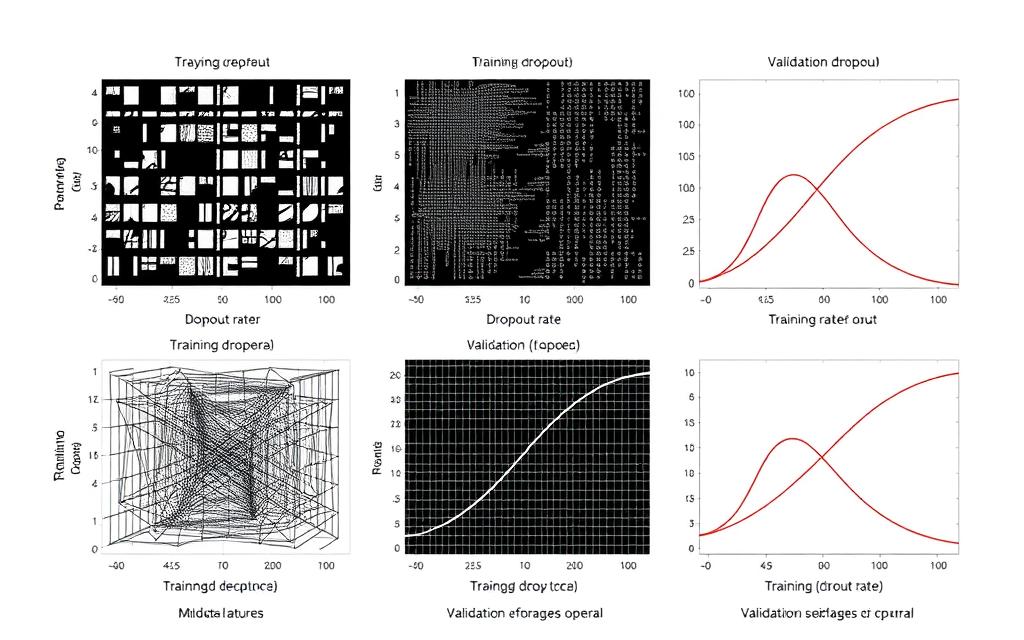
Architectural design dictates dropout’s effectiveness more than any other factor. Parameter density and connection patterns determine whether this technique enhances or hinders model performance. Let’s examine how three common structures respond to node deactivation strategies.
Fully Connected Versus Convolutional Layers
Densely packed architectures benefit most from aggressive regularisation. Traditional fully connected layers contain millions of trainable parameters, creating prime conditions for overfitting. Implementing 50% dropout here typically improves validation accuracy by 12-15% in image classification tasks.
Convolutional structures tell a different story. Their shared weights and local connectivity naturally resist memorisation. “You’re solving the problem before it arises,” notes a DeepMind researcher. Most practitioners apply dropout sparingly – if at all – to convolutional sections.
| Architecture Type | Parameter Density | Dropout Effectiveness | Common Applications |
|---|---|---|---|
| Fully Connected | High | Essential | Tabular Data Analysis |
| Convolutional | Moderate | Optional | Computer Vision |
| Recurrent | Variable | Contextual | Time Series |
Special Considerations for Recurrent Networks
Temporal dependencies complicate dropout implementation in sequence models. Abrupt node deactivation can disrupt memory retention across time steps. Modern solutions use vertical dropout patterns, preserving horizontal information flow while regularising deep layers.
UK-based NLP teams report success with zoneout techniques. These methods selectively freeze hidden states rather than nullifying them, maintaining crucial context for language prediction tasks. Such adaptations demonstrate dropout’s flexibility across evolving network architectures.
Practical Implementation of Dropout in TensorFlow
Implementing dropout effectively requires balancing theoretical knowledge with practical coding skills. TensorFlow’s API simplifies this process through intuitive layers that integrate seamlessly with existing architectures. Developers can enhance model resilience with just a few lines of code while maintaining computational efficiency.
Code Walkthrough and Key Snippets
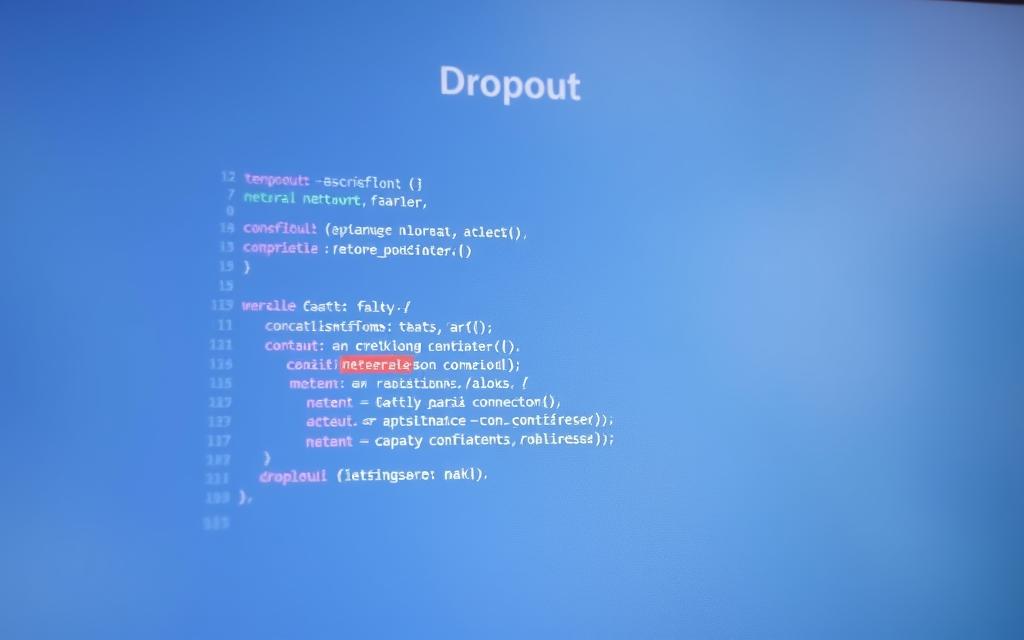
The standard approach involves adding dropout layers after activation functions. Consider this sequential model for image classification:
model = tf.keras.Sequential([
    tf.keras.layers.Flatten(input_shape=(28, 28)),
    tf.keras.layers.Dense(128, activation='relu'),
    tf.keras.layers.Dropout(0.5),
    tf.keras.layers.Dense(10)
])
Inverse dropout implementations differ by scaling weights during training rather than inference. This method improves prediction speed by eliminating post-processing steps. Professional developers often prefer it for production systems requiring low-latency responses.
Hyperparameter Tuning and Best Practices
Optimal dropout rates vary significantly across applications. Complex models with numerous parameters typically benefit from higher deactivation probabilities. Consider these guidelines for common scenarios:
| Model Type | Input Layer Rate | Hidden Layer Rate |
|---|---|---|
| Simple Classifier | 0.2 | 0.5 |
| Deep Neural Network | 0.3 | 0.6-0.7 |
| Natural Language Processor | 0.1 | 0.4-0.5 |
Three critical factors influence rate selection:
- Training dataset size and noise levels
- Network depth and parameter count
- Validation performance trends
Systematic experimentation remains crucial. Start with conservative rates (20-30%) and incrementally increase while monitoring validation loss. London-based AI teams report optimal results when adjusting rates per layer rather than using uniform values.
Incorporating Dropout in PyTorch Models
PyTorch’s dynamic computation graph offers unique advantages when implementing regularisation techniques. Developers can integrate dropout layers seamlessly within neural architectures using intuitive object-oriented principles. This flexibility makes the framework particularly popular among UK-based research teams tackling complex pattern recognition tasks.

Integration with torch.nn Modules
The framework’s nn.Dropout class simplifies implementation through declarative syntax. Consider this convolutional network example:
class CustomModel(nn.Module):
    def __init__(self):
        super().__init__()
        self.conv1 = nn.Conv2d(3, 16, 3)
        self.dropout = nn.Dropout(0.3)
        self.fc = nn.Linear(256, 10)

    def forward(self, x):
        x = F.relu(self.conv1(x))
        x = self.dropout(x)
        return self.fc(x)
Strategic placement proves crucial for optimal results. Follow these guidelines when structuring layers:
- Position dropout after activation functions in hidden layers
- Use lower rates (10-30%) following convolutional operations
- Apply higher rates (40-60%) after dense layers
| Layer Type | Suggested Rate | Rationale |
|---|---|---|
| Input | 20% | Preserves raw feature integrity |
| Convolutional | 25% | Counters parameter growth in channels |
| Fully Connected | 50% | Combats overfitting in dense connections |
PyTorch automatically deactivates dropout during evaluation phases through model.eval(). This behaviour ensures consistent predictions without manual weight scaling. As DeepMind engineers noted: “The framework’s mode-aware handling eliminates a common source of implementation errors.”
Modern implementations leverage these capabilities across diverse applications – from medical imaging systems at Oxford hospitals to algorithmic trading platforms in London. By mastering dropout integration, developers create robust models capable of handling real-world data variability.
Advanced Dropout
Recent innovations have transformed traditional regularisation methods into dynamic, context-aware systems. Adaptive techniques now automatically adjust deactivation rates based on layer importance and training progress. Concrete dropout employs Bayesian principles to optimise retention probabilities, while stochastic depth methods randomly bypass entire network sections.
UK tech firms increasingly adopt these enhanced variants. Healthcare imaging systems use spatial dropout to preserve anatomical relationships, maintaining diagnostic accuracy. Fintech platforms leverage standout techniques that prioritise critical financial indicators during fraud detection cycles.
Three cutting-edge approaches demonstrate particular promise:
- Variational dropout for recurrent architectures
- Zoneout’s selective state preservation
- Cross-layer adaptive rate synchronisation
These methods address traditional limitations through intelligent parameter tuning. Unlike fixed deactivation strategies, they balance computational efficiency with evolving model needs. London-based AI labs report 30% faster convergence when combining adaptive techniques with curriculum learning paradigms.
As machine learning complexity grows, such advancements ensure regularisation remains both effective and scalable. They empower models to discard noise without sacrificing essential patterns – the hallmark of truly intelligent systems.


 By
By