

Designing effective computational models requires careful consideration of architecture depth. This guide explores key principles for structuring artificial intelligence systems inspired by biological processes. The choice between simplicity and complexity often determines a model’s success in real-world applications.
Modern architectures typically feature an input stage, processing nodes, and output mechanisms. While deeper structures can capture intricate patterns, they demand more resources and training time. Beginners frequently overcomplicate designs, unaware that starting small often yields better initial results.
We analyse how different configurations affect performance across tasks like image recognition or predictive analytics. Practical examples demonstrate when added complexity becomes justified – and when it hinders progress. Industry standards emphasise balancing computational efficiency with accuracy demands.
That concept is easier to apply once you relate it to machine learning engineer salary in in a model-building workflow.
This resource provides actionable frameworks for making informed decisions about your system’s structure. Discover how to avoid common errors while optimising for speed, scalability, and problem-specific requirements. By understanding these trade-offs, practitioners can develop solutions that deliver results without unnecessary overheads.
Introduction to Neural Networks and Their Layers
Modern machine learning systems rely on interconnected processing units organised into distinct groups. These groups form the backbone of computational models that power everything from voice assistants to medical diagnostics. The arrangement of these components directly impacts a system’s ability to learn patterns and make accurate predictions.
Understanding Neural Network Architecture
Artificial intelligence systems mirror biological learning through interconnected nodes arranged in specific configurations. Three primary components govern data flow: reception points, transformation units, and decision-making mechanisms. Each plays a unique role in processing information and refining outputs through successive stages.
Reception points handle raw data like temperature readings or pixel values. Transformation units then analyse relationships between these inputs, building increasingly abstract representations. Decision mechanisms convert these insights into actionable results, such as identifying objects in photos or forecasting stock trends.
The Role of Input, Hidden, and Output Layers
Initial components act as gateways, standardising diverse data formats for consistent processing. Middle sections perform the heavy lifting – detecting edges in images or syntax in text. Final stages package refined insights into user-friendly formats, whether classifying emails or predicting energy usage.
More complex tasks often require additional transformation units between input and output stages. However, excessive additions can lead to diminishing returns. Balancing depth with practicality remains crucial for maintaining efficiency while tackling sophisticated challenges.
Understanding the Components of a Neural Network
At the core of artificial intelligence systems lie fundamental building blocks that enable pattern recognition and decision-making. These elements work in concert to process information, adapt through training, and deliver reliable outputs across diverse applications.
Neurons, Weights and Biases
Neurons act as decision-making units, receiving multiple inputs and producing single outputs. Each connection between these units carries numerical values called weights, which amplify or dampen signals. Biases act as adjustable thresholds, determining when a neuron becomes active.
During training, weights evolve to prioritise important features in datasets. For instance, an image recognition system might assign higher weights to edge-detection patterns. Biases prevent irrelevant background noise from triggering unnecessary activations, sharpening the model’s focus.
Activation Functions and Their Importance
These mathematical tools determine whether and how strongly neurons respond to inputs. The Rectified Linear Unit (ReLU) remains popular for its simplicity, zeroing negative values while preserving positive ones. Sigmoid functions map outputs between 0-1, ideal for probability estimates.
Modern neural networks often use tailored activation choices based on task requirements. Tanh functions suit scenarios requiring negative outputs, while specialised variants address vanishing gradient issues in deep architectures. Selecting appropriate functions directly influences a model’s ability to capture complex relationships.
Exploring the Role of Hidden Layers
The true magic of modern AI systems unfolds between input and output stages. These intermediate components transform raw data into meaningful insights through progressive refinement. Their arrangement determines whether models recognise cat photos or predict weather patterns effectively.
Why Hidden Components Drive Complexity
Hidden layers act as feature factories, converting basic inputs into sophisticated representations. Early stages might detect light gradients in images, while subsequent ones assemble these into recognisable shapes. This hierarchical processing mimics human learning patterns, building understanding through layered abstraction.
Each tier simplifies tasks for the next. Lower sections handle pixel-level details, middle tiers interpret textures, and upper units identify complete objects. This staged approach enables systems to tackle problems too intricate for manual coding.
Adding more processing tiers increases a model’s analytical depth. However, it also demands greater computational resources and training data. Over-engineering often leads to diminishing returns, where extra complexity yields minimal accuracy gains.
Striking the right balance requires understanding your task’s demands. Simple classification might need three processing tiers, while language translation could require dozens. Successful architectures match depth to problem scope without unnecessary embellishment.
How many layers of neural network?
Selecting the right configuration for computational models remains a pivotal challenge in AI development. Architectural choices directly influence a system’s capacity to extract meaningful patterns while maintaining operational efficiency. Foundational concepts in neural architecture suggest starting with minimal viable structures before considering expansion.

Deciding on Hidden Components
Research reveals single hidden layer networks can approximate complex functions given sufficient neurons. The MNIST dataset demonstrates this practically – achieving 97% accuracy with one processing tier. Adding a second tier boosts results to 98%, showcasing measurable improvements without excessive complexity.
Balancing Depth and Efficiency
Deeper architectures often require fewer neurons per layer but demand more training resources. Performance metrics like validation accuracy and loss convergence help determine when extra tiers add value. Overly complex models risk overfitting, particularly with limited training data.
Modern approaches prioritise empirical testing over theoretical assumptions. Begin with one or two hidden tiers, then incrementally assess if added depth improves outcomes. This strategy maintains computational efficiency while ensuring each new layer serves a clear purpose in enhancing model capability.
Starting with a Single Hidden Layer
Mastering neural networks begins with foundational structures that balance capability and simplicity. A single hidden layer architecture serves as an effective starting point, achieving impressive results like 97% accuracy on MNIST datasets. This approach minimises computational demands while maintaining robust learning potential – ideal for both newcomers and resource-conscious projects.
Benefits of a Simple Architecture
Single hidden layer networks train significantly faster than deeper models, often completing tasks in minutes rather than hours. Their streamlined design requires less memory, making them practical for standard hardware setups. This efficiency doesn’t compromise effectiveness – these models excel at identifying patterns in structured data and straightforward classification tasks.
Developers gain clearer insights into decision-making processes with simplified architectures. Fewer parameters mean easier identification of underperforming components during troubleshooting. The relationship between inputs and outputs remains more transparent, aiding model interpretation and refinement.
Research supports this approach through the universal approximation theorem. It confirms that one hidden layer networks can model any continuous function given adequate neurons. This theoretical foundation explains their success across applications from sales forecasting to medical diagnostics.
Practical implementations demonstrate their versatility. Energy consumption predictors and customer churn analysers frequently employ single-tier designs. These solutions deliver reliable performance without the complexity overheads of deeper networks, proving that simplicity often aligns with practicality in machine learning.
Gradually Increasing Network Depth
Building robust AI solutions requires strategic expansion of computational architectures. The incremental addition of processing tiers allows developers to balance analytical power with practical constraints. This methodical approach prevents resource waste while maximising model efficiency.

Start with minimal viable structures, then assess performance gaps through validation metrics. Each added tier should address specific shortcomings rather than pursuing arbitrary complexity. Early-stage models often reveal whether basic architectures suffice or require enhancement.
Balancing Complexity with Training Time
Deep neural architectures demand careful resource management. Consider these critical factors:
- Parameter growth: Each new layer introduces thousands of adjustable values needing extensive training data
- Convergence patterns: Monitor validation loss curves for signs of stagnation or divergence
- Hardware limits: Training time escalates exponentially with depth – four-layer models may take 8x longer than two-layer equivalents
Hierarchical learning benefits emerge clearly in multi-tier systems. Initial layers might detect basic shapes in images, while subsequent ones assemble these into recognisable objects. This staged processing mirrors human cognitive development but requires precise calibration.
“Adding depth without purpose creates computational bloat, not intelligence. The sweet spot lies where performance gains outweigh resource costs.”
Practical implementations show deeper models achieve superior results on complex tasks like natural language processing. However, simpler architectures often outperform overly complex ones for straightforward classification. Regular benchmarking against baseline models ensures each added layer delivers tangible benefits.
Best Practices for Designing Deep Neural Networks
Constructing high-performance artificial intelligence systems demands strategic architectural planning. Developers should prioritise proven frameworks from established research over custom designs, particularly when tackling complex tasks like medical imaging analysis or voice synthesis.

Optimising Network Structure
Modern approaches favour adapting existing architectures through transfer learning rather than building from scratch. This technique reduces training time by up to 70% while maintaining accuracy, as demonstrated in Oxford University’s 2023 computer vision benchmarks.
Effective designs balance width and depth based on task requirements. Wider configurations excel at capturing diverse data features, while deeper arrangements enable hierarchical pattern recognition. Regularisation methods like dropout layers and batch normalisation prove essential for preventing overfitting in multi-tier systems.
“The most efficient deep learning models aren’t the deepest, but those that strategically combine architectural wisdom with computational pragmatism.”
Residual connections have revolutionised training stability in networks exceeding 50 tiers. These shortcuts allow gradients to flow unimpeded, addressing vanishing signal issues that previously limited depth. Pairing these with adaptive optimisation algorithms like Adam ensures reliable convergence across diverse datasets.
Practical implementation requires meticulous monitoring of validation metrics. Tools like TensorBoard help visualise layer interactions, enabling data-driven decisions about structural adjustments. This approach maintains efficiency while scaling capabilities for evolving project demands.
Customising Layers for Specific Machine Learning Tasks
Tailoring neural architectures to specialised applications unlocks new potential in artificial intelligence. Strategic modifications to computational frameworks enable systems to address unique challenges in fields ranging from medical imaging to autonomous vehicles. This approach combines architectural flexibility with domain-specific insights to create highly effective solutions.
Utilising Transfer Learning
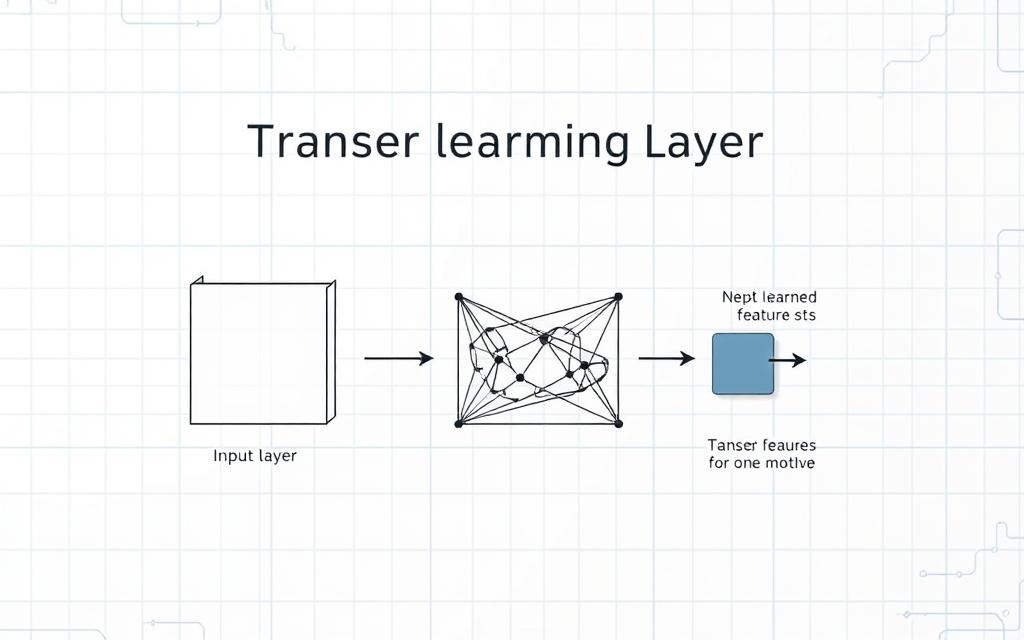
Transfer learning revolutionises model development by repurposing existing architectures for new challenges. A facial recognition system’s early processing tiers, for instance, can be adapted to analyse hairstyles. These reused components handle universal patterns like edge detection, freeing resources for learning task-specific details.
Lower layers in pretrained models often capture fundamental features applicable across domains. Texture analysis units from an image classification network might prove equally effective for material quality inspection. This cross-pollination of capabilities reduces training time by up to 65% compared to building from scratch.
Effective implementation requires strategic freezing of selected tiers. Domain adaptation techniques allow networks trained on urban landscapes to analyse satellite imagery with minimal adjustments. The key lies in identifying which components retain relevance and which require retraining for new data characteristics.
“Freezing initial layers preserves general feature extraction, while retraining upper tiers enables specialisation – this balance drives efficient knowledge transfer across related tasks.”
Task similarity dictates architectural modifications. When tackling problems aligned with original training data, deeper layer reuse proves effective. For divergent applications, replacing upper processing tiers while preserving foundational elements often yields optimal results. This methodology maintains computational efficiency while expanding model versatility.
Common Mistakes and Pitfalls in Layer Configuration

Architectural missteps can derail AI projects before training begins. A frequent error involves overengineering structures for simple tasks – using six processing tiers where two suffice. This wastes computational resources and increases overfitting risks with limited datasets.
Developers often neglect hardware limitations when adding components. Complex configurations may crash systems during backpropagation or require impractical training times. Always assess memory constraints and processing power before finalising designs.
Improper layer adjustments create bottlenecks in data flow. Mismatched activation functions between tiers disrupt gradient propagation, while inconsistent node counts hinder feature extraction. Regular validation checks during prototyping prevent these silent performance killers.
Seasoned practitioners recommend starting with minimalist architectures and scaling judiciously. Document each modification’s impact on accuracy and resource use. This disciplined approach avoids “complexity creep” while maintaining operational efficiency.


 By
By