

Modern artificial intelligence relies on immense compute power, making hardware selection critical for efficient model development. Accelerating neural network training requires specialised processors capable of handling thousands of simultaneous operations. This guide analyses current solutions balancing raw power with cost-effectiveness, helping practitioners optimise their setups.
Parallel processing capabilities remain the cornerstone of effective AI hardware, with newer architectures offering significant leaps in tensor core efficiency. Recent advancements in memory bandwidth and precision calculations directly impact training times for complex models like transformers and diffusion networks.
We evaluate options across three categories: consumer-grade cards for individual researchers, workstation solutions for team projects, and enterprise systems handling large-scale deployments. Each tier presents distinct performance-per-pound considerations, particularly when scaling multi-processor configurations.
That broader commercial context becomes clearer when you look at bi vs ai key differences and how teams apply AI in day-to-day operations.
Cloud-based alternatives continue gaining traction, offering flexible access to cutting-edge hardware without upfront investments. However, on-premises installations maintain advantages for data-sensitive applications requiring dedicated resources.
Overview of Deep Learning and GPU Importance
Artificial intelligence breakthroughs hinge on solving complex mathematical puzzles at unprecedented scales. This computational revolution demands hardware that transforms theoretical models into practical results efficiently. Specialised processors bridge this gap by executing billions of operations per second across layered neural architectures.
Traditional processors struggle with simultaneous data processing, a fundamental requirement for modern AI systems. Parallel architectures thrive here, leveraging thousands of cores to accelerate matrix calculations central to neural networks. Such capabilities cut training cycles dramatically – what once took months now resolves in days.
The shift from sequential to concurrent computing reshaped resource strategies across industries. Researchers prioritise hardware that balances memory bandwidth with precision, enabling rapid iteration on transformer models and generative algorithms. Scalability becomes paramount as parameter counts exceed billions in cutting-edge architectures.
Cost-effective solutions now empower smaller teams to compete in AI development. Cloud services offer temporary access to high-end resources, while on-premises installations cater to sensitive data workflows. Strategic hardware investments directly influence innovation velocity, making processor selection a critical first step in any AI project lifecycle.
What GPU for deep learning?
Choosing acceleration hardware forms the backbone of efficient neural architecture development. Modern systems demand components that handle massive parameter counts while maintaining energy efficiency. Three critical factors dominate selection criteria: memory bandwidth, computational throughput, and framework integration.
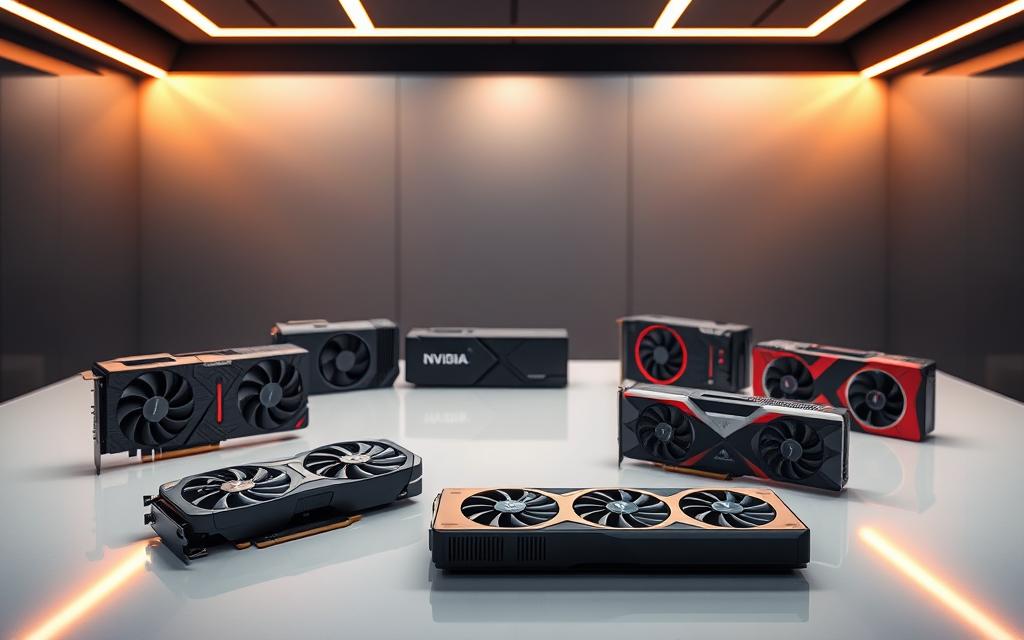
VRAM capacity directly determines which architectures you can train locally. Larger models like vision transformers require 24GB+ memory buffers to process batch data without costly swapping. Mid-range options often prove insufficient for cutting-edge research tasks.
Processing throughput, measured through TFLOPS ratings, dictates training speed. Specialised tensor cores boost performance for mixed-precision calculations common in modern frameworks. Units supporting FP16 operations typically achieve 2-3× speed improvements over standard FP32 processing.
Compatibility remains essential for seamless workflow integration. Verify driver support for TensorFlow or PyTorch distributions before purchasing. Many enterprise solutions offer preconfigured environments that reduce setup complexity.
Budget-conscious teams should analyse total ownership costs, including electricity and cooling. Multiple mid-tier cards sometimes outperform single flagship models while offering better scalability. Cloud alternatives become viable when projects require temporary capacity spikes.
Emerging precision formats like INT8 quantisation enable faster inference without accuracy loss. These features prove particularly valuable for deployment scenarios where latency matters. Always cross-reference benchmark results against your specific use cases before finalising hardware decisions.
Essential GPU Specifications for AI Performance
Accelerating artificial intelligence workflows demands careful evaluation of hardware capabilities. Five critical specifications determine real-world efficiency:
TFLOPS ratings quantify raw processing power through trillions of operations per second. Higher values enable faster model training, particularly for complex generative architectures. Current flagship processors achieve 80+ TFLOPS in FP32 precision modes.
Memory configurations involve twin considerations: capacity and speed. Large VRAM buffers (24GB+) handle billion-parameter models, whilst bandwidth above 1TB/s prevents data bottlenecks. Recent architectures employ advanced compression to maximise throughput.
Precision formats dictate accuracy-versus-speed trade-offs:
- FP32: Full precision for sensitive calculations
- FP16: Half-precision acceleration
- TF32: Balanced approach for tensor operations
Parallel processing units come in two flavours. CUDA cores manage general computations across thousands of threads. Dedicated tensor cores accelerate matrix maths – the foundation of neural networks. Modern designs allocate 30-40% of silicon space to these specialised units.
Architectural generation significantly impacts software compatibility. Newer designs support optimised instruction sets and energy-efficient protocols. Teams should prioritise recent releases to future-proof their investments.
Unleashing the Power of Tensor Cores
Modern neural architectures demand processors that crunch numbers faster than ever. Specialised tensor cores revolutionise how systems handle mathematical heavy lifting. These components transform complex calculations into streamlined operations, cutting training times dramatically.
Understanding Tensor Cores Operation
Traditional processors tackle tasks sequentially, creating bottlenecks in AI workflows. Tensor cores operate differently, executing 4×4 matrix multiplications in single clock cycles. This parallel approach slashes processing time – a 32×32 matrix operation drops from 504 cycles to 235.
Mixed-precision calculations further boost efficiency. By combining FP16 and FP32 formats, these units maintain accuracy whilst reducing memory demands. Developers gain flexibility to optimise for speed or precision without compromising results.
Advantages in Matrix Multiplication
Matrix operations form the backbone of neural network training. Tensor cores accelerate these processes through architectural synergy with common AI frameworks. Their design aligns perfectly with convolutional layers and attention mechanisms in modern models.
Recent generations support multiple data types:
- BF16 for enhanced numerical stability
- TF32 balancing speed and accuracy
- INT8 for lightning-fast inference
Real-world tests show 1.5-2× training speed improvements when leveraging these features. Smart memory management prevents data bottlenecks, ensuring cores operate at peak efficiency. Proper implementation can halve project timelines without sacrificing model quality.
Memory Bandwidth: The Lifeline of GPU Performance
System efficiency in modern AI hinges on overcoming data movement challenges. Even the fastest processors stall when memory can’t keep pace. High-speed components often sit idle, waiting for critical information to arrive from storage buffers.
Memory bandwidth determines how quickly data flows between processing cores and VRAM. When training large models, this metric becomes more vital than raw compute power. Tests show tensor cores operate at 45-65% capacity during GPT-3 training due to delayed data delivery.
| GPU Model | Memory Bandwidth | Speed Improvement |
|---|---|---|
| V100 | 900 GB/s | Baseline |
| A100 | 1,555 GB/s | 1.73× |
| H100 | 2,040 GB/s | 2.26× (Est.) |
Newer memory technologies address these limitations. GDDR6X and HBM2e modules push boundaries, delivering over 2TB/s in flagship cards. These advancements allow complex models to train faster by reducing processor downtime.
Bandwidth requirements scale with model parameters and batch sizes. Teams working on billion-parameter architectures should prioritise solutions with 1,500+ GB/s throughput. Smaller projects might manage with 800-1,200 GB/s systems.
Optimisation strategies help maximise existing hardware. Adjusting batch sizes and preloading frequently used data minimises memory bottlenecks. Proper configuration can boost utilisation rates by 15-20% in bandwidth-constrained environments.
Navigating the GPU Memory Hierarchy
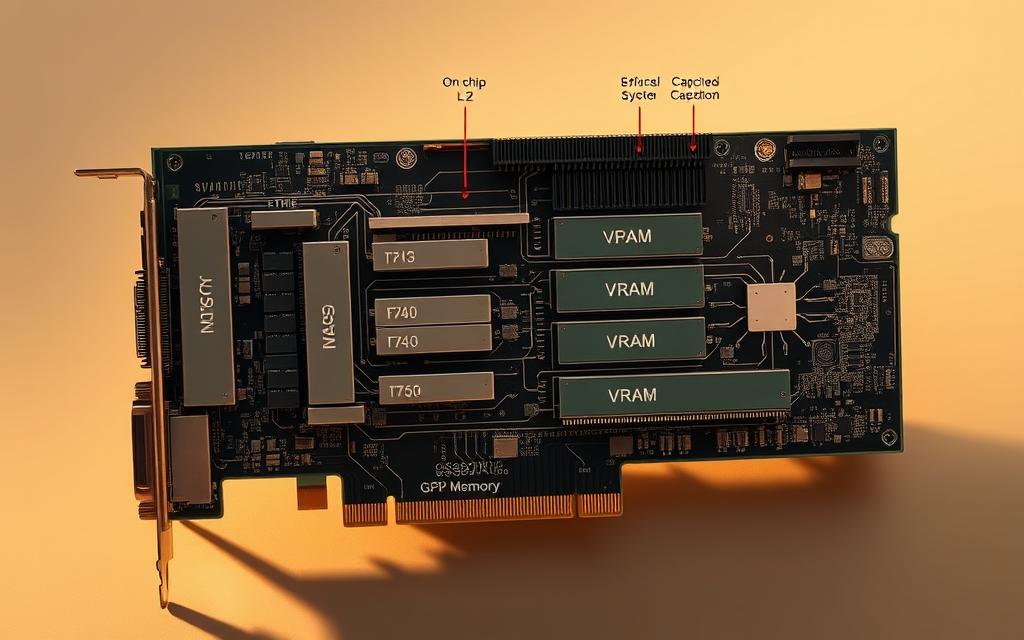
Efficient neural network training relies on understanding memory architecture nuances. Modern processors employ a multi-layered approach to balance capacity with access speed. This hierarchy spans from expansive storage pools to lightning-fast temporary registers.
Global memory offers substantial capacity (80GB+) but suffers high latency (~380 cycles). Newer architectures combat this through smarter caching – Ada’s 72MB L2 cache outperforms Ampere’s 6MB version by 1.5-2× in matrix operations. Intermediate cache layers bridge the gap between raw storage and processing cores.
| Memory Type | Capacity | Access Latency |
|---|---|---|
| Registers | Per-core | 1 cycle |
| L1/Shared | 128KB/SM | 34 cycles |
| L2 Cache | 72MB (Ada) | 200 cycles |
| Global | 80GB | 380 cycles |
Developers can boost performance through strategic data placement. Frequently accessed parameters belong in shared memory (128KB per SM), while bulk datasets reside in global storage. This tiered approach minimises idle processor time during complex calculations.
Memory-aware programming techniques yield tangible benefits. Optimised kernels using register allocation achieve 200× faster access than global memory calls. Such practices prove vital when training billion-parameter models where latency compounds exponentially.
Architectural improvements continue reshaping best practices. Larger caches in modern designs reduce reliance on slower memory tiers, particularly beneficial for transformer models and attention mechanisms. Teams should prioritise hardware with advanced memory hierarchies for future-proof scalability.
Performance Metrics and Deep Learning Efficiency

Evaluating system effectiveness requires moving beyond basic benchmarks to examine real-world workflow dynamics. True efficiency emerges when computational resources align with specific neural architectures’ demands. Three key factors dominate assessments:
- Throughput consistency across varied batch sizes
- Memory bandwidth utilisation rates
- Framework-specific optimisation levels
Batch size adjustments demonstrate measurable impacts, with doubling batch capacity yielding 13.6% throughput gains in controlled tests. This optimisation becomes viable when VRAM capacity permits larger data chunks. However, memory-bound systems see diminishing returns beyond optimal thresholds.
“Scaling across multiple processors introduces overheads that can erode 22-38% of potential gains in distributed setups.”
Network latency and synchronisation delays prove particularly costly in multi-card configurations. Teams should analyse scaling efficiency percentages before expanding hardware clusters. Practical testing reveals ideal card counts vary by model complexity and framework implementation.
Memory bandwidth metrics serve as critical indicators, distinguishing compute-bound from memory-constrained scenarios. Systems achieving 85%+ bandwidth utilisation typically maximise tensor core engagement. Architectural enhancements like asynchronous data transfers further reduce idle cycles between operations.
Validating performance requires representative workload testing rather than synthetic benchmarks. Real-world evaluations account for data pipeline variations and preprocessing demands absent from controlled measurements.
Consumer GPU Roundup: RTX 4090 and RTX 5090
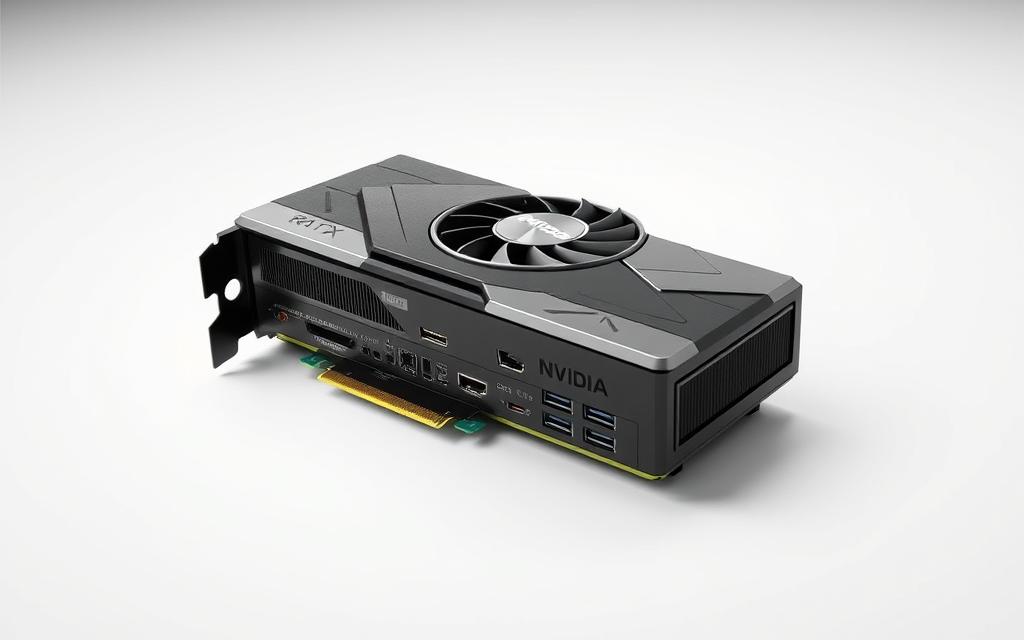
Cutting-edge consumer graphics solutions now rival professional-grade hardware for neural network development. The GeForce RTX 4090 demonstrates this shift, leveraging Ada Lovelace architecture to deliver workstation-level throughput. With 24GB GDDR6X memory and 1TB/s bandwidth, it handles billion-parameter models previously requiring data centre hardware.
Third-generation RT cores accelerate ray tracing operations by 2× compared to previous generations. This benefits generative architectures using complex scene rendering. Tensor core improvements enable 83 TFLOPS performance in FP16 precision – sufficient for rapid iteration on diffusion models and language processors.
Memory configuration proves critical for modern workflows. The RTX 4090’s 384-bit bus width sustains high throughput during intensive training sessions. Thermal design enhancements maintain clock speeds above 2.5GHz under sustained loads, crucial for multi-day computations.
Anticipated RTX 5090 specifications suggest further memory capacity gains and architectural refinements. Early leaks indicate potential 28GB buffers optimised for transformer-based architectures. These developments could narrow the gap between consumer and enterprise solutions.
Cost-conscious teams should note diminishing returns beyond the RTX 4090’s capabilities. Its balance of price-to-performance makes it ideal for individual researchers and small studios. Cloud alternatives remain preferable for temporary scaling needs, but local hardware retains advantages for sensitive data pipelines.


 By
By