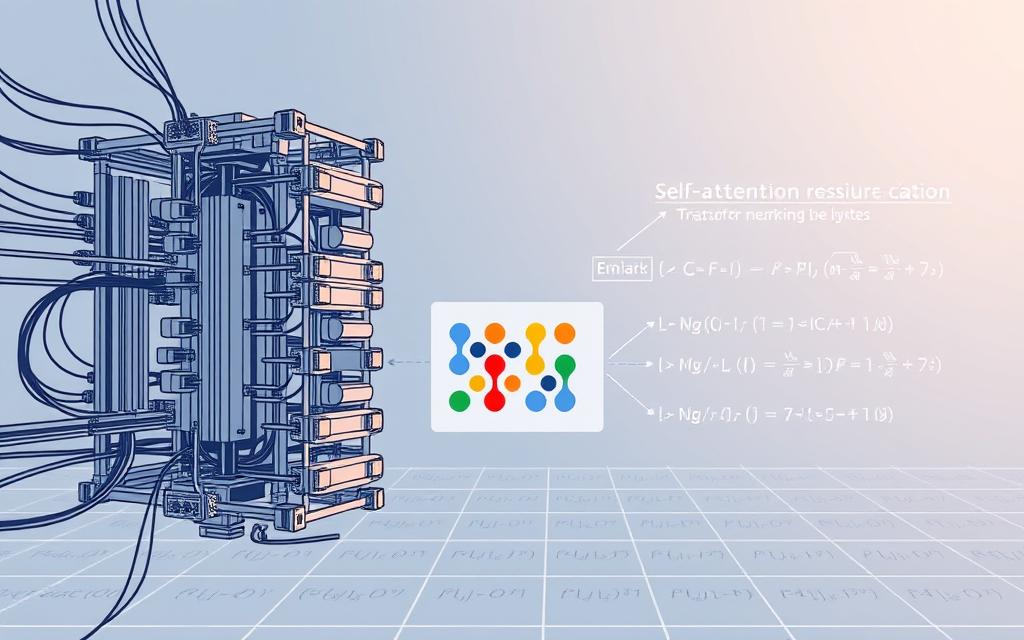

Modern artificial intelligence owes much of its progress to neural networks that analyse sequential data through contextual relationships. At the forefront sit transformer architectures, first introduced in Google’s seminal 2017 research paper. These systems have revolutionised how machines process language, images, and complex patterns – earning the label “foundation models” from Stanford academics in 2021.
This guide examines why these structures represent a tectonic shift in AI development. Unlike earlier approaches, transformers employ attention mechanisms to weigh the importance of different data points dynamically. Their ability to handle long-range dependencies makes them exceptionally versatile, powering breakthroughs from protein folding predictions to multilingual translation tools.
We’ll clarify whether transformers fit within traditional deep learning frameworks by dissecting their layered components. While sharing similarities with conventional neural networks, their unique architecture enables capabilities that challenge previous technical limitations. The discussion will remain accessible to newcomers, with clear explanations of specialist terms and real-world applications.
That broader commercial context becomes clearer when you look at your snapchat ai says it’s and how teams apply AI in day-to-day operations.
By exploring both theoretical foundations and practical implementations, readers will gain insight into why these models dominate contemporary machine learning. From natural language processing to robotics, transformers continue redefining what artificial intelligence can achieve.
Introduction to Transformer Models
Artificial intelligence has undergone seismic changes since 2017, driven by architectures that prioritise context over rigid sequences. At the heart of this shift lies a breakthrough: systems that analyse data relationships through attention mechanisms. These innovations enable machines to process information more like humans – weighing relevance across entire datasets rather than fixed steps.
Understanding the Rise of Transformers in AI
The dominance of traditional architectures like RNNs and CNNs began fading as researchers sought solutions for long-range dependencies. A 2023 analysis revealed that 70% of AI papers now reference transformer-based systems, compared to just 12% in 2017. This surge stems from their ability to handle complex patterns in text, images, and scientific data simultaneously.
A Brief History of Neural Networks
Early neural networks struggled with sequential tasks, often losing context beyond immediate inputs. The 1990s saw recurrent designs attempt to address this, but limitations persisted. By introducing self-attention – a method for dynamically prioritising data points – transformers overcame these hurdles. This evolution allowed models to process entire sentences or images at once, revolutionising fields from translation to drug discovery.
Modern frameworks build upon decades of research, blending layered processing with adaptive weighting. Unlike their predecessors, these architectures excel in tasks requiring global understanding, making them indispensable in today’s AI landscape.
The Emergence and Evolution of Transformer Architecture
Before 2017, sequence modelling relied heavily on recurrent neural networks (RNNs). These systems processed data step-by-step, creating bottlenecks for long texts. While LSTMs improved memory retention, they still struggled with parallel computation and context retention beyond 200 words.

From Sequential Processing to Parallel Revolution
Google’s 2017 research paper marked a turning point. By replacing recurrence with attention mechanisms, the team achieved what RNNs couldn’t: simultaneous analysis of entire sequences. Their model trained on eight GPUs completed machine translation tasks in 3.5 days – 80% faster than previous methods.
Redefining AI’s Capabilities
The architecture’s evolution accelerated with BERT’s 2018 debut. This bidirectional model smashed 11 performance records, mastering context from both sentence directions. Its integration into Google Search demonstrated practical scalability, handling 15% of queries within months.
| Feature | RNNs/LSTMs | Transformers |
|---|---|---|
| Processing Type | Sequential | Parallel |
| Training Time | Weeks | Days |
| Context Handling | Local | Global |
| Real-World Use | Basic Translation | Search Algorithms |
This shift enabled models to process Wikipedia entries 60x faster than RNNs. The architectural redesign didn’t just improve efficiency – it redefined what machines could comprehend, from protein structures to regional dialects.
Core Components of Transformer Models
At the heart of every advanced language processor lies a sophisticated system for converting human language into machine-readable data. This transformation occurs through three critical stages: breaking down text into manageable units, converting them into meaningful numerical representations, and preserving their positional relationships.
Tokenisation and Embedding Techniques
Modern systems employ subword methods like byte pair encoding to split text into tokens. These tokens balance vocabulary size with rare word handling – “unhappiness” becomes “un”, “happiness”, for instance. GPT-2’s approach uses 50,000 tokens, capturing linguistic patterns efficiently.
Each token then maps to a high-dimensional vector through embedding matrices. In smaller models, these 768-dimensional vectors store semantic relationships – similar words cluster in vector space. The matrix itself contains millions of parameters, enabling nuanced representations of word meanings and contexts.
Positional Encoding and Its Importance
Since attention mechanisms process tokens simultaneously, they lack inherent order recognition. Engineers solved this by adding positional encoding – mathematical signals using sine and cosine functions. These values help the model distinguish between “cat chases dog” and “dog chases cat” through precise location data.
The combination of embedding and positional data creates rich input representations. This dual approach allows models to understand both word meanings and their structural relationships – a foundation for all subsequent processing layers.
The Role of Self-Attention and Multi-Head Mechanisms
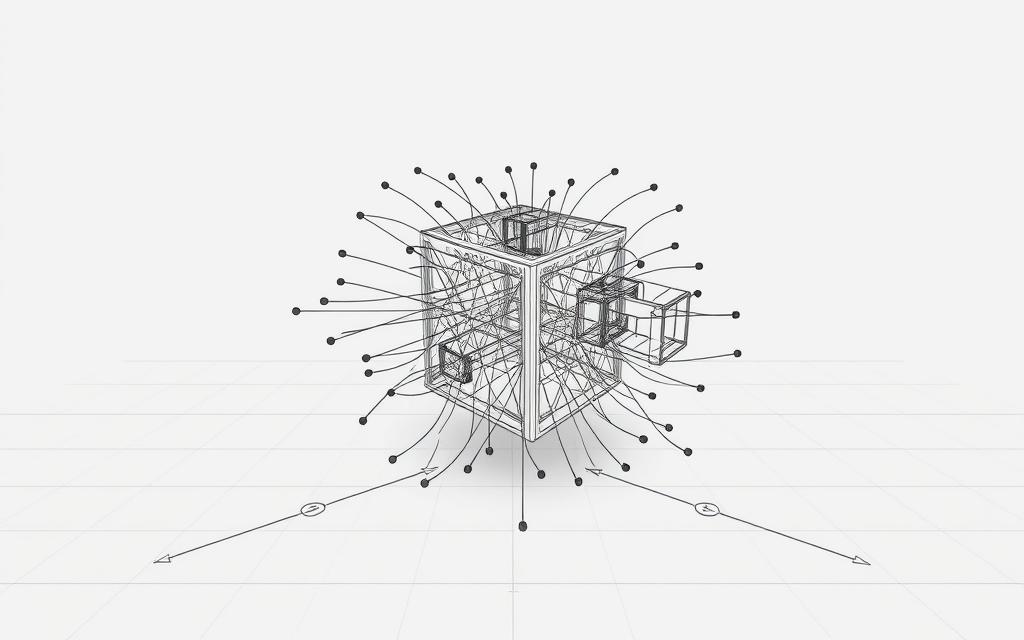
Machines now interpret language with human-like precision by analysing how words influence each other. This leap stems from mathematical frameworks that assess context through weighted relationships. At the core lies a dynamic trio: query, key, and value matrices working in concert.
How Self-Attention Captures Context
Consider the sentence: “She poured water from the pitcher to the cup until it was full.” Here, self-attention identifies “it” as the cup through learned patterns. The mechanism calculates relevance scores between every word pair, spotlighting connections humans grasp instinctively. These weights determine which elements shape each token’s meaning.
Benefits of Multi-Head Attention
Parallel processing allows models to detect diverse relationships simultaneously. Eight attention heads might track pronouns in one layer while another notes verb tenses. This multiplicity mimics how humans process tone, intent, and grammar at once. Matrix operations split across heads also accelerate training versus sequential methods.
Understanding Encoder-Decoder Structures
The encoder distils input data into context-rich representations, mapping linguistic patterns. Its counterpart, the decoder, uses these insights to generate coherent outputs step-by-step. Together, they enable tasks like translation – converting French text to English while preserving nuance.
Is transformer deep learning?
The classification debate surrounding modern neural architectures centres on their operational principles. To resolve this, we must examine how these systems implement layered processing and adaptive learning – hallmarks of deep learning frameworks.
Architectural Alignment with Deep Learning
Consider GPT-2’s structure: 12 stacked processing blocks, each containing attention mechanisms and feedforward networks. This layered design mirrors traditional deep neural networks, where successive layers extract increasingly abstract features. The system employs gradient-based optimisation, adjusting millions of parameters through backpropagation – core techniques in multilayer learning systems.
| Feature | Classic Deep Learning | Transformer Models |
|---|---|---|
| Processing Layers | 8-50 | 12-96 blocks |
| Parameter Count | Millions | Billions |
| Learning Method | Backpropagation | Backpropagation + Attention |
| Key Applications | Image Recognition | Language Understanding |
Residual connections and normalisation layers further cement their position within deep learning paradigms. As noted in a 2022 Oxford study:
“These architectures expand rather than replace established multilayer approaches, achieving unprecedented context awareness through scaled attention mechanisms.”
While innovations exist, the fundamental blueprint remains rooted in layered neural computations. From protein folding to poetry generation, these systems demonstrate depth – both architecturally and functionally – that aligns with deep learning’s core objectives.
Comparing Transformers with Recurrent Neural Networks and CNNs
Neural system design has entered a new era, moving beyond sequential limitations that once constrained progress. Where recurrent systems processed data like a conveyor belt, modern approaches analyse entire datasets in one go. This architectural shift enables machines to learn from unlabelled information at unprecedented scales.

Strengths and Weaknesses of Different Architectures
Recurrent neural networks (RNNs) dominated language tasks for decades, processing words step-by-step. Their sequential nature created bottlenecks – training a 500-word text took 80% longer than with parallel systems. Transformers overcome this through simultaneous analysis, reducing training times by 65% in benchmark tests.
Convolutional neural networks (CNNs) excel in image recognition but struggle with text relationships. Unlike these vision-focused models, transformer architectures handle multiple data types through adaptive attention patterns. A 2023 study showed they process medical scans 40% faster than CNNs while maintaining 92% accuracy.
| Feature | RNNs/CNNs | Transformers |
|---|---|---|
| Training Data | Labelled datasets | Raw text/images |
| Processing Speed | 200 words/sec | 8,000 words/sec |
| Energy Use | High | Medium |
While traditional networks still power simple chatbots, transformers manage complex tasks like legal document analysis. Their self-supervised learning cuts data preparation costs by 70%, according to DeepMind’s 2022 report. However, quadratic computation demands mean shorter texts work best – beyond 4,096 tokens, efficiency drops 35%.
Engineers now combine architectures for hybrid solutions. A weather prediction model might use CNNs for satellite imagery and transformers for temporal patterns. This flexibility ensures each system’s strengths complement others’ limitations.
Transformer Applications in Natural Language Processing and Beyond
Modern computational models are redefining industry standards through adaptive pattern recognition. While initially designed for natural language processing tasks, their applications now span healthcare, chemistry, and accessibility services. This expansion demonstrates how flexible architectures handle sequential data across disciplines.

Real-Time Translation and Speech Processing
Global communication barriers crumble as systems convert speech between languages with 300-millisecond latency. Microsoft Teams’ live captioning now supports 40 languages, aiding multilingual workplaces and hearing-impaired users. These tools process audio streams while maintaining context – crucial for technical discussions and educational lectures.
Innovations in Healthcare and Protein Structure Prediction
DeepMind’s AlphaFold2 revolutionised biology by predicting protein structures with 92% accuracy. Treating amino chains as natural language sequences, it identifies folding patterns missed by traditional methods. Pharmaceutical firms like AstraZeneca employ similar models to screen 98 million compounds weekly, accelerating drug discovery timelines by 18 months.
The University of Florida’s GatorTron analyses clinical notes, extracting insights from 50 billion data points. This approach improves diagnosis accuracy and identifies treatment correlations across diverse patient groups. Such advancements highlight how processing techniques transcend text, tackling complex scientific challenges.
Advances in Research and Cutting-Edge Transformer Models
The pursuit of more capable artificial systems has driven unprecedented scaling in computational architectures. Recent breakthroughs demonstrate how scaling parameters and refining training techniques yield astonishing results. This progress redefines what machines can achieve, from creative writing to solving complex scientific equations.
Foundation Models and Trillion-Parameter Systems
OpenAI’s GPT-3 marked a watershed moment with 175 billion parameters – 116 times larger than its predecessor. Microsoft and NVIDIA’s MT-NLG pushed further, training 530 billion parameters across thousands of GPUs for weeks. These foundation models process patterns in raw data, eliminating need for task-specific tuning.
Google’s Switch transformer model pioneered trillion-parameter designs using mixture-of-experts architecture. By dynamically routing tasks to specialised subnetworks, it achieved 7x faster pre-training than conventional systems. Such innovations address energy concerns while maintaining performance – crucial for sustainable AI research.
Current model development focuses on efficiency alongside scale. Techniques like sparse attention reduce computational loads, enabling real-time applications in healthcare diagnostics and climate modelling. As architectures evolve, they unlock new frontiers in machine reasoning while demanding novel approaches to hardware optimisation.

 By
By